Korean Parasol Culture: Why Koreans Carry Umbrellas on Sunny Days
Korean Parasol Culture: Why Koreans Carry Umbrellas on Sunny Days
Picture a bright summer afternoon in Seoul. The sky is clear, the sun is blazing, and not a single cloud is in sight. There is absolutely no rain in the forecast. And yet, walking down almost any street in the city, you’ll notice something that stops first-time visitors in their tracks: a significant portion of the people around you are carrying umbrellas.
Not for rain. Not as a fashion accessory. For the sun.
This is the world of 양산 (yangsan) — the Korean sun parasol — and it is one of the most quietly fascinating expressions of Korean daily culture you’ll encounter. An object that looks almost identical to a regular umbrella but serves an entirely different purpose: creating a personal circle of shade in the middle of a blazing Korean afternoon. For millions of Koreans, the yangsan is not a curiosity or a seasonal novelty. It is as essential to leaving the house on a sunny day as putting on shoes.
This guide explores everything behind Korean parasol culture — why Koreans love their yangsan, what Korea’s climate has to do with it, the deep cultural roots of fair skin in Korean society, and why Koreans consistently choose a parasol over sunglasses when it comes to protecting themselves from the sun.
Table of Contents
- What Is a Yangsan?
- Why Koreans Love the Yangsan
- Korea’s Climate and Why the Sun Hits Differently Here
- The Korean Tradition of Fair Skin and What It Means
- Parasol vs. Sunglasses: Why Koreans Choose the Yangsan
- Who Uses Yangsan in Korea?
- How the Korean Beauty Industry Shaped Parasol Culture
- Yangsan Design: What Makes a Korean Sun Parasol Different
- Tips for Visitors: Should You Buy a Yangsan in Korea?
- Final Thoughts
What Is a Yangsan?
The word 양산 (yangsan) is made up of two Chinese characters: 陽 (yang), meaning sun or sunlight, and 傘 (san), meaning umbrella. Together they literally mean sun umbrella — a name that describes the object with complete precision.
A yangsan looks, at first glance, almost identical to a standard rain umbrella. Same shape, same structure, same basic mechanism of opening and closing. The differences are in the details: yangsan are typically lighter in weight, more compact when folded, and constructed from fabrics with UV-blocking properties — often coated with a special lining that reflects or absorbs ultraviolet radiation rather than simply blocking rain. Many high-quality yangsan are rated for UV protection the same way sunscreen is, with specific UPF (Ultraviolet Protection Factor) ratings indicating how much solar radiation the fabric blocks.
In Korean, the distinction between a rain umbrella (우산, usan) and a sun parasol (양산, yangsan) is clear and consistently observed. Koreans know the difference, use the correct word for each, and generally own both. Using a rain umbrella as a sun parasol is considered a reasonable substitute in a pinch, but a dedicated yangsan is considered the proper tool for sun protection — and the Korean market for yangsan reflects this, offering an extraordinary range of designs, materials, and price points specifically for sun use.
Why Koreans Love the Yangsan
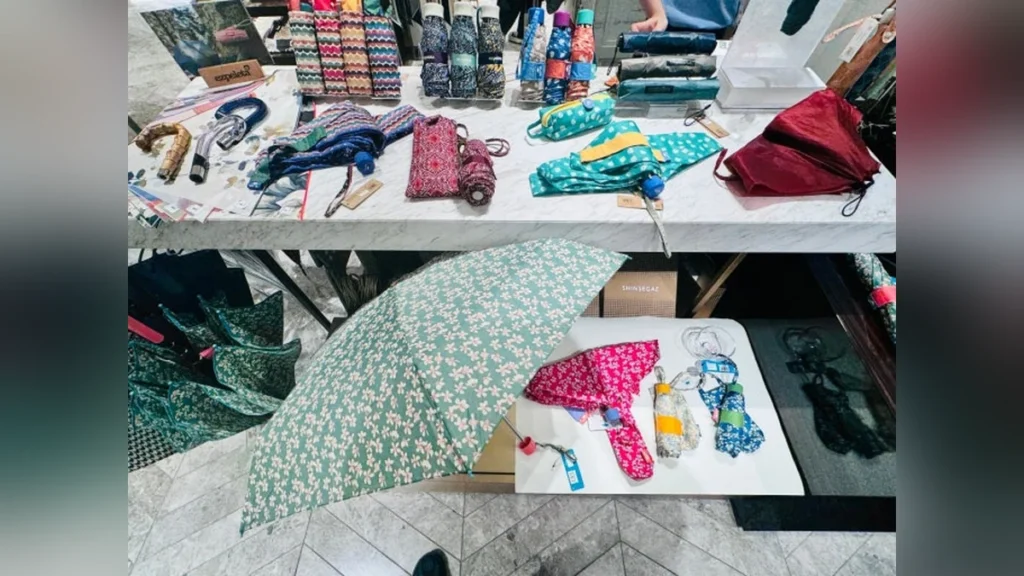
The simplest answer to why Koreans love the yangsan is also the most direct: it works. Remarkably, immediately, and in a way that any other sun protection method struggles to match. Walking under a yangsan on a hot Korean summer day reduces the temperature you feel on your skin almost instantly. The shade it creates is personal and portable — it moves with you, covers you completely from above, and blocks direct sunlight from reaching your face, neck, and shoulders regardless of which direction the sun is coming from.
Compare this to sunscreen, which requires application and reapplication, can feel heavy or greasy in humid heat, and does nothing to reduce the physical sensation of heat on the skin. Compare it to a hat, which covers the top of the head but leaves the face and much of the neck exposed. Compare it to staying in the shade — which requires the shade to be there in the first place, and limits where you can go.
The yangsan solves all of these problems simultaneously. It is complete, portable, and immediately effective. In a country where summer temperatures regularly climb above 35°C with high humidity, and where the intensity of midday UV radiation is among the highest in the developed world, this level of protection is not a luxury. For many Koreans, it is a rational and practical response to an environment that genuinely demands it.
Beyond the practical argument, there is a social and aesthetic dimension to yangsan use in Korea that should not be underestimated. Carrying a yangsan is a signal — of self-care, of skin awareness, of a certain attention to one’s own wellbeing and appearance that Korean culture strongly values. In a society where skincare is taken seriously at every level, from the elaborate multi-step routines that Korean beauty culture has made globally famous to the careful daily management of sun exposure, using a yangsan is entirely consistent with a broader set of values about how you treat your skin and your body.
Korea’s Climate and Why the Sun Hits Differently Here
To fully understand Korean parasol culture, you need to understand what Korean summer actually feels like — because the climate is a significant part of why yangsan use is not merely habitual but genuinely necessary.
Korea experiences a continental climate with four distinct seasons, and its summers are intense in a specific way that visitors from more temperate climates are often not prepared for. Summer in Korea — roughly June through September — brings a combination of high temperatures, high humidity, and UV radiation levels that make outdoor midday exposure genuinely uncomfortable and potentially damaging in a short amount of time.
The Temperature Reality
During peak summer, temperatures in Seoul and most major Korean cities regularly reach 33°C to 37°C, with humidity levels that make the felt temperature — the heat index — significantly higher. A 35°C day at 70% humidity can feel closer to 40°C or above. In these conditions, direct sunlight on unprotected skin is not just unpleasant. It is something that drives people to seek shade with a directness and urgency that people from cooler climates do not always understand until they experience it firsthand.
UV Radiation in Korea
South Korea’s geographic position means that summer UV radiation levels are high — consistently in the Very High or Extreme range on the UV index during peak midday hours from June through August. The UV index in Seoul on a clear summer day can reach 9 or 10 during midday hours, levels at which dermatologists worldwide recommend significant sun protection for anyone spending extended time outdoors.
The combination of heat and UV is what makes the yangsan so practically compelling. It does not just reduce UV exposure — it simultaneously reduces the felt heat, provides physical shade that cools the skin, and creates a genuinely more comfortable environment for the person beneath it. In this climate, the question is not really why Koreans use yangsan. It is more honestly: why wouldn’t they?
The Rainy Season Connection
There is also a seasonal rhythm to Korean parasol culture that gives it an additional layer of practicality. Korea’s summer begins with 장마 (jangma) — the monsoon rainy season — which typically runs through late June and July, bringing heavy and unpredictable rainfall. During jangma, almost everyone already carries an umbrella everywhere as a standard precaution. When the rainy season ends and the hot, clear days of late summer arrive, the habit of carrying an umbrella is already in place — and transitioning from a rain umbrella to a yangsan is a natural, easy continuation of existing behavior rather than the adoption of something entirely new.
The Korean Tradition of Fair Skin and What It Means
To understand Korean parasol culture at its deepest level, you have to engage with something that goes far beyond practical sun protection: Korea’s long-standing cultural tradition of valuing fair, even skin tone, and the role that tradition plays in shaping everyday behavior around sun exposure.
Historical Roots
The preference for fair skin in Korean culture is ancient, predating the modern beauty industry by centuries. In traditional Korean society — as in many East Asian cultures — pale skin was associated with high social status, specifically because it indicated that a person did not engage in outdoor manual labor. Farmers, laborers, and those who worked outdoors had darker, sun-tanned skin as an inevitable consequence of their work. Aristocrats, court ladies, and those of privileged status who spent their lives indoors had pale, protected complexions. Fair skin, in this historical reading, was not simply an aesthetic preference — it was a visible marker of class, education, and social position.
This historical association gave rise to beauty standards and skincare practices that persist in modified and evolved form today. While the explicit class dimension has largely dissolved in contemporary Korean society, the aesthetic preference for clear, even, luminous skin has not. It has been absorbed into and amplified by modern Korean beauty culture in ways that have made Korean skincare products and routines globally influential.
The Contemporary Dimension
In modern Korea, the desire for fair and even skin tone is expressed primarily through a sophisticated skincare culture rather than explicit class signaling. Multi-step skincare routines featuring brightening serums, vitamin C products, sunscreens, and carefully formulated toners are standard for a significant portion of the Korean population, male and female alike.
Within this culture, sun avoidance is understood as one of the most effective and evidence-based approaches to maintaining fair, even skin. Dermatologists consistently identify UV radiation as the single largest contributor to skin darkening, uneven tone, and premature aging — and Korean consumers, who tend to be well-informed about skincare science, take this seriously. The yangsan is not just a fashion choice or a cultural habit. It is, in the framework of Korean skincare values, a first-line defense against the most significant threat to the skin outcome that Korean beauty culture prizes most highly.
Not Exclusively a Women’s Tradition
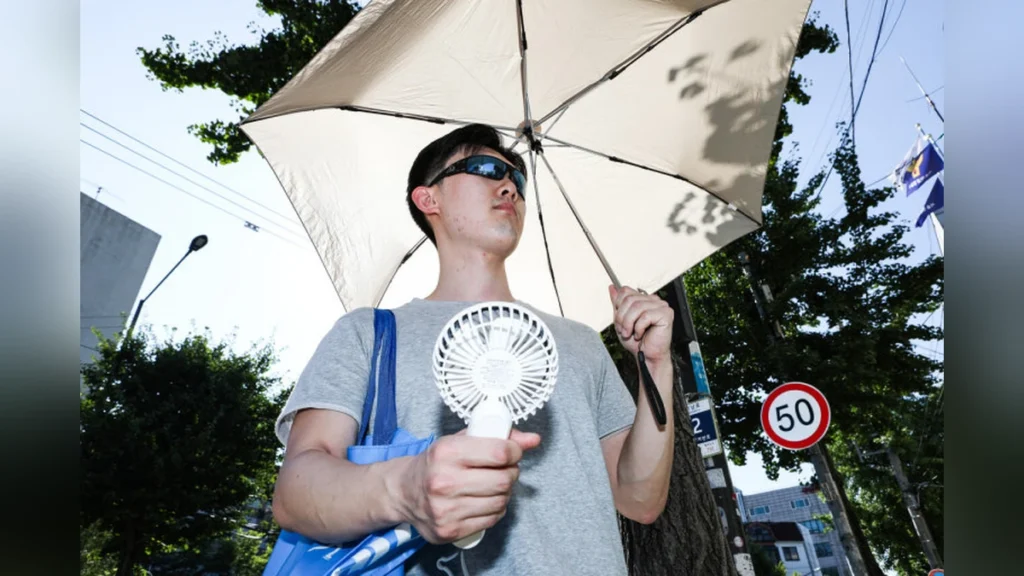
It is worth noting explicitly that yangsan use in Korea is not limited to women, though women do represent the majority of users. Men carry yangsan too — particularly older generations, but also an increasing number of younger Korean men as male skincare culture has expanded and the stigma around sun protection tools for men has declined. This broadening of yangsan use across gender lines is itself a reflection of how deeply skin awareness has become embedded in Korean culture as a whole.
Parasol vs. Sunglasses: Why Koreans Choose the Yangsan
For visitors from cultures where sunglasses are the primary response to bright sunlight, the prevalence of yangsan use in Korea raises an obvious question: why a parasol instead of sunglasses? The answer reveals a great deal about both the practical logic and the cultural values behind Korean parasol culture.
Coverage Is the Key Argument
Sunglasses protect the eyes and the immediately surrounding skin from UV radiation and glare. This is genuinely valuable. But sunglasses leave the rest of the face, the nose, the cheeks, the forehead, the neck, and the shoulders entirely unprotected. For someone whose primary concern is protecting their skin broadly — maintaining even skin tone, preventing sun-induced hyperpigmentation, avoiding the drying and aging effects of UV radiation across their entire face and exposed body — sunglasses address a small fraction of the problem.
A yangsan, by contrast, creates a zone of complete shade over the entire upper body. Every part of the face is covered. The neck and shoulders are shaded. The arms may be partially protected. The physical intensity of heat on the skin is reduced. In terms of comprehensive sun protection, there is simply no comparison between what a yangsan and a pair of sunglasses actually deliver.
The Skincare Logic
Korean beauty culture is built on a holistic approach to skin health that treats every centimeter of the face as worthy of equal protection. The elaborate routines that have made Korean skincare famous — the cleansing, the toning, the essences, the serums, the moisturizing, the sunscreen — are premised on the idea that skin health is the result of consistent, comprehensive care rather than selective protection of certain areas. A sunglasses-only approach, in this framework, is logically inconsistent. If you have just applied vitamin C serum and broad-spectrum SPF 50 sunscreen to your entire face as part of a careful morning routine, using only sunglasses when you go outside and leaving the rest of your face in direct sunlight is working against everything you have just done.
The yangsan completes the logic of a comprehensive skincare approach by providing physical sun protection on top of topical sun protection — a combination that dermatologists consistently identify as more effective than either approach alone.
Glare vs. Heat
There is also a sensory argument. Sunglasses solve the glare problem — the discomfort of bright light entering the eyes. The yangsan solves a different problem: the physical discomfort of direct heat and radiation on the skin. These are not the same problem, and the solution to one does not address the other. Many Koreans use both — yangsan and sunglasses together — for comprehensive outdoor comfort. But if forced to choose between the two on a hot Korean summer afternoon, the yangsan addresses a larger and more physically significant source of discomfort than sunglasses alone.
Who Uses Yangsan in Korea?
Korean parasol culture cuts across demographic lines in ways that might surprise visitors who initially assume it is primarily a practice among older women or a particular social group.
Women of all ages are the most visible and most frequent yangsan users in Korea. From university students to working professionals to grandmothers at the market, the yangsan is a near-universal accessory for Korean women who spend time outdoors during the summer months. The range of yangsan styles available — from simple functional models to elaborate designer pieces — reflects the breadth of this user base.
Older men form a significant secondary user group. Many Korean men of older generations carry and use yangsan as a matter of course, particularly in rural areas and in contexts where extended outdoor time is common — markets, parks, agricultural settings, long walking commutes.
Younger men are an increasingly visible yangsan user group, driven partly by the general expansion of skincare culture among younger Korean males and partly by shifting attitudes toward gender and personal care. Young Korean men who maintain careful skincare routines increasingly treat yangsan use as a logical extension of that commitment.
Parents with young children frequently use yangsan to protect both themselves and their children from direct sun exposure, often while simultaneously applying sunscreen and dressing children in sun-protective clothing. The protective instinct that drives yangsan use for adults is, in this context, extended to cover the most vulnerable family members.
How the Korean Beauty Industry Shaped Parasol Culture
The modern yangsan market in Korea is deeply intertwined with the Korean beauty and skincare industry — one of the most innovative and commercially powerful in the world — and the relationship between the two has amplified parasol culture significantly over the past two decades.
As Korean skincare brands built global audiences for their products and the concept of skin protection as a daily, year-round commitment became increasingly mainstream both within Korea and internationally, the yangsan was positioned not as an old-fashioned or eccentric accessory but as a scientifically grounded skin protection tool consistent with the values that drive the entire Korean beauty ecosystem.
Korean cosmetics brands began incorporating UPF ratings and UV-reflective fabric technology into yangsan design, applying the same evidence-based language they use for sunscreen products. Skincare influencers and beauty content creators incorporated yangsan use into their content as part of holistic sun protection routines. Department stores and beauty specialty retailers devoted significant floor space to premium yangsan collections alongside their skincare product lines.
The result was a cultural reinforcement loop: as Korean beauty culture grew in global influence and domestic prestige, the practices associated with serious skin protection — including yangsan use — gained additional credibility and visibility. The yangsan went from being simply a traditional sun protection tool to being an explicit expression of the skincare values that Korean beauty culture is built on.
Yangsan Design: What Makes a Korean Sun Parasol Different
Not all yangsan are created equal, and the range of options available in the Korean market reflects both the seriousness with which sun protection is taken and the aesthetic sensibilities of a culture that sees no reason why a functional object should not also be beautiful.
UV Protection Technology
The most important functional differentiator between yangsan is the UV protection rating of the fabric. Quality Korean yangsan are rated for UPF — Ultraviolet Protection Factor — in the same way that sun-protective clothing is. A UPF 50+ rating, which is the highest standard, indicates that the fabric blocks at least 98% of UV radiation, making it significantly more protective than many sunscreens that are not consistently reapplied. Many Korean yangsan in the mid-to-premium price range carry UPF 50+ certification and use specialized coated or woven fabrics designed specifically for UV blocking rather than simply repurposing rain umbrella material.
The Inside Coating
One of the key features of quality Korean yangsan is a dark-colored inner lining — typically black, silver, or dark grey — that absorbs and reflects UV radiation rather than allowing it to filter through. This inner coating makes a significant difference in the actual protection the yangsan provides, and experienced yangsan users in Korea specifically look for it when purchasing. A yangsan without this dark inner coating offers less UV protection than one with it, and Korean consumers are generally aware of this distinction.
Size and Shape
Korean yangsan tend toward a relatively compact size compared to the large, dramatic parasols of some other cultures. A typical Korean yangsan is sized to cover one person comfortably, with a canopy large enough to shade the face, neck, and upper shoulders without being so large as to become difficult to carry or navigate in crowded urban environments. Folding yangsan — compact enough to fit in a standard tote bag or backpack — are extremely popular for everyday carry, particularly among commuters and those who move between indoor and outdoor environments throughout the day.
Aesthetic Design
Korean yangsan span an enormous aesthetic range — from simple, functional solid-color models in neutral tones to elaborately designed pieces featuring embroidery, printed patterns, lace trim, and premium materials like natural bamboo handles and UV-protective silk. The premium end of the Korean yangsan market produces pieces that are genuinely beautiful objects as well as functional sun protection tools — handcrafted items that reference traditional Korean craft aesthetics while incorporating modern UV technology.
Tips for Visitors: Should You Buy a Yangsan in Korea?
If you are visiting Korea during the summer months — and experiencing what a clear Korean July afternoon actually feels like — the answer is almost certainly yes.
Where to buy. Yangsan are sold almost everywhere in Korea during the summer season. Department stores carry the widest range including premium options. Accessory shops, market stalls, convenience stores, and even some pharmacies stock affordable functional models. Major Korean fashion and lifestyle brands produce yangsan as part of their seasonal accessory collections. For the best combination of quality and price, mid-range accessory stores and the accessory sections of major retailers are a reliable starting point.
What to look for. Check the UPF rating on the label if it is available — UPF 50+ is the standard you want. Look for a dark inner coating. Check the weight — a yangsan you will actually carry needs to be light enough to hold comfortably for extended periods. And make sure the folding mechanism works smoothly before you buy — the quality of the folding hardware varies significantly at different price points.
What to expect to pay. A functional, decent-quality yangsan with proper UV protection can be found for between ₩15,000 and ₩40,000 at mid-range retailers. Premium and designer options range from ₩50,000 to several hundred thousand won for handcrafted or luxury-branded pieces. For a short-term visitor who wants sun protection without a major investment, the budget-to-mid-range options are entirely adequate.
How to carry it. Most modern folding yangsan are compact enough to fit in a tote bag or large purse. The habit of Korean yangsan users is to keep it accessible at all times when outdoors — pulling it out when you step into direct sun and folding it when you move indoors or into shade. Once you start using one, this becomes almost automatic remarkably quickly.
Final Thoughts
Korean parasol culture is one of those small but revealing windows into a society’s values and daily logic that rewards attention. On the surface, it is simply a practical response to strong sunlight: carry an umbrella, stay in the shade, keep your skin protected. But the deeper you look, the more layers you find — centuries of cultural tradition around skin tone, a modern skincare industry built on the seriousness of UV protection, a climate that makes strong sun protection genuinely necessary, and a practical sensibility that reaches for the most comprehensive solution rather than the most fashionable one.
The yangsan is not glamorous. It is not the sexiest accessory you’ll see on a Seoul street. But it is effective, logical, and — once you’ve spent an afternoon under one on a Korean summer day — surprisingly difficult to argue with.
Walk the streets of any Korean city on a sunny afternoon, and you’ll see yangsan everywhere: carried by grandmothers on their way to the market, by young women in office clothes on their lunch break, by men in their fifties heading to a park, by university students walking between buildings. Each one creating a small personal circle of shade, making the Korean summer just slightly more bearable, protecting something — skin, comfort, tradition, identity — that matters.
That is what an umbrella without rain looks like. And in Korea, it makes complete, beautiful sense.