Korean Baseball Cheering Culture: How to Enjoy a Game Like a Local
Korean Baseball Cheering Culture: How to Enjoy a Game Like a Local
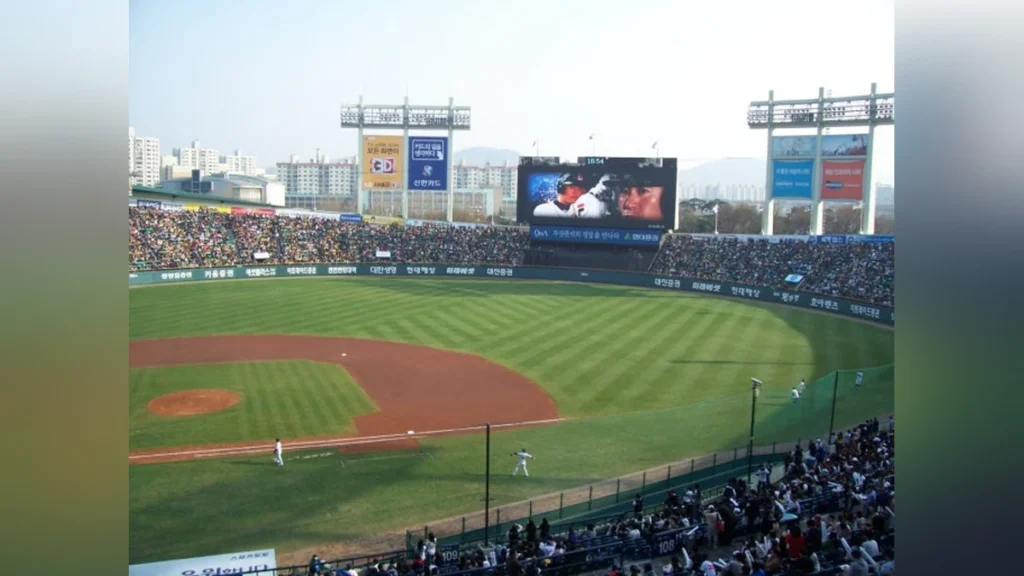
If you’ve ever watched a Korean baseball game — in person or even on video — you already know that something is very different about it. The stadium isn’t quiet between pitches. It isn’t politely applauding good plays. It is loud, choreographed, relentless, and absolutely electric from the first inning to the last out. Korean baseball cheering culture is unlike anything else in the sports world, and experiencing it for the first time is the kind of thing people genuinely talk about for years.
The good news is that you don’t need to know anything about baseball to have the time of your life at a KBO game. You don’t need to follow the league, memorize statistics, or understand every rule. What you need is a ticket, a snack, and the willingness to stand up, sing along, and let yourself get swept up in one of the most joyful collective experiences that Korean culture has to offer.
This guide will walk you through everything — how the cheering works, what to eat, where to sit, and exactly how to enjoy a Korean baseball game like you’ve been doing it your whole life.
Table of Contents
- Why Korean Baseball Cheering Culture Is Different
- The Cheer Leaders: The People Running the Show
- How the Chants and Songs Work
- The Iconic Inflatable Thunder Sticks
- What to Eat and Drink at a Korean Baseball Game
- How to Pick Your Team and Your Seat
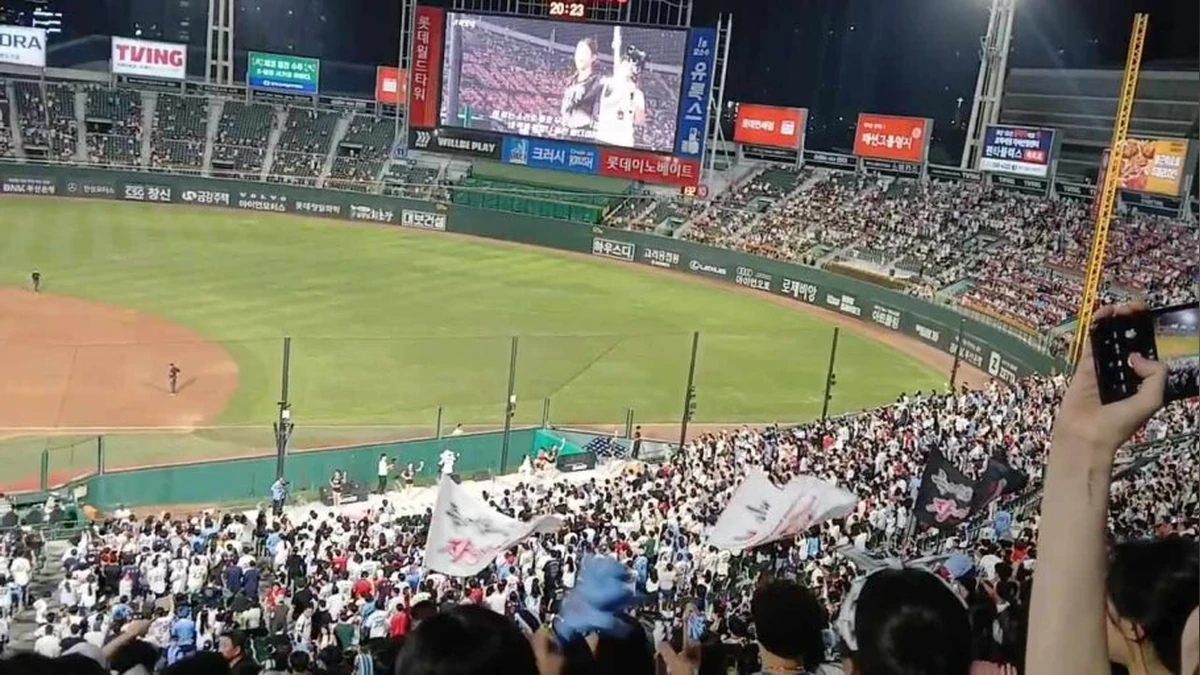
- What to Expect from the Crowd
- Tips for First-Timers at a KBO Game
- Final Thoughts
Why Korean Baseball Cheering Culture Is Different
Walk into a Major League Baseball game in the United States and the atmosphere is pleasant. There’s a crowd, there’s music between plays, there’s a vendor walking past with hot dogs. But the cheering is largely reactive — people respond when something good happens, and the rest of the time it’s fairly calm.
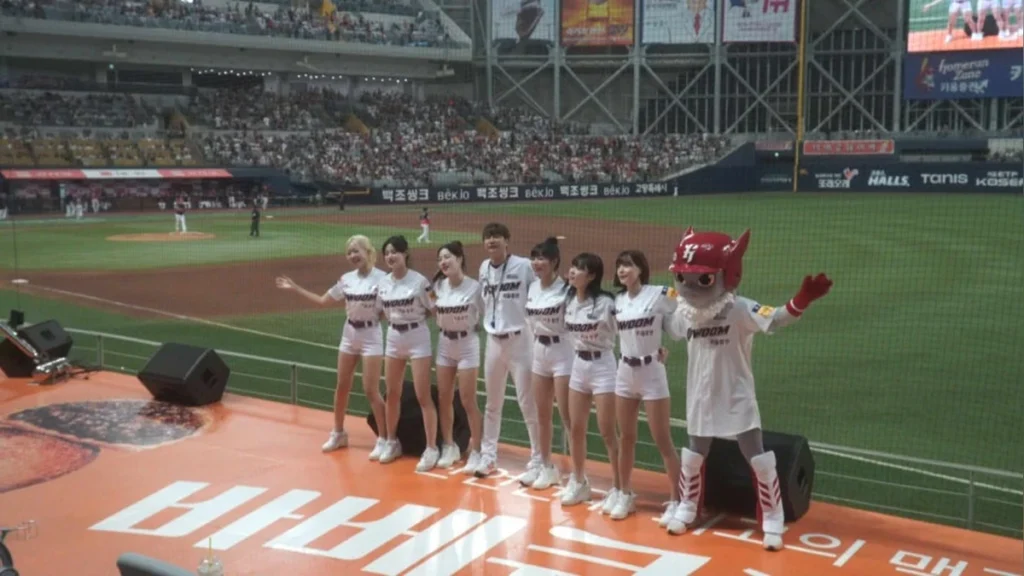
Walk into a KBO stadium in Korea and the experience is completely inverted. The cheering is constant. There is organized, synchronized chanting for virtually every batter who steps up to the plate. There are team-specific songs for individual players. There are full crowd choreographies — fans standing and sitting in unison, waving together, clapping in specific rhythms at specific moments. And every single bit of it is coordinated by a professional cheer squad standing on a platform in the outfield stands, microphone in hand, leading the entire section like a conductor leading an orchestra.
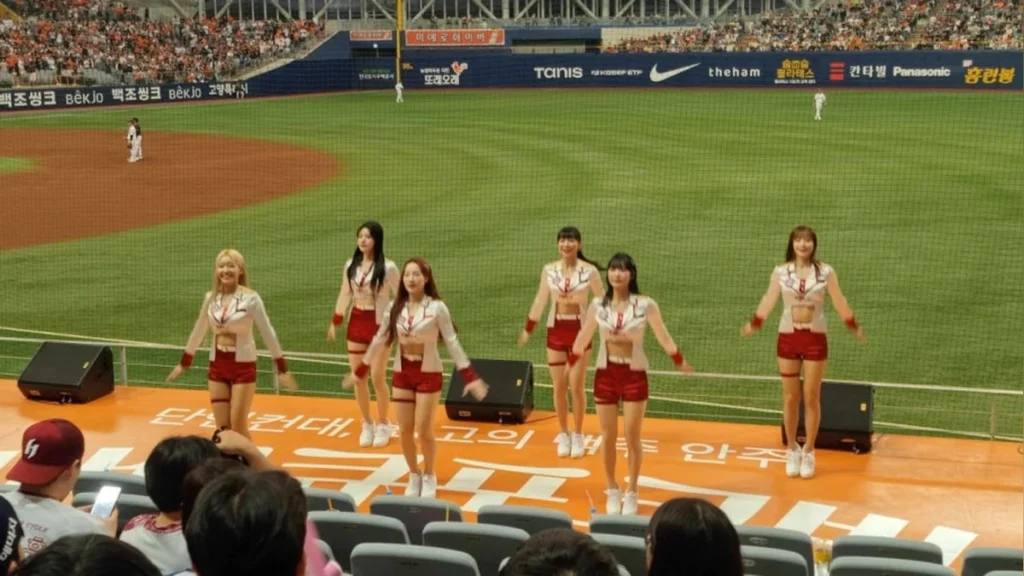
Korean baseball cheering culture did not happen by accident. It grew out of Korea’s broader culture of group participation and collective energy — the same instinct that produces extraordinary synchronized performances at K-pop concerts and the intense communal viewing events that accompany major international competitions. Koreans are exceptionally good at doing things together, and nowhere is that more visible and more fun than at a baseball stadium on a warm evening in summer.
The result is a game-day experience that feels less like watching a sport and more like participating in a celebration — regardless of the score.
The Cheer Leaders: The People Running the Show
The single most important thing to understand about Korean baseball cheering culture is the role of the 치어리더 (chieo-rideo) — the cheerleaders — and the 응원단장 (eung-won-dan-jang), the head cheer leader.
Every KBO team has a professional cheer squad. These are not the sideline performers you might associate with American sports. Korean baseball cheerleaders are the actual engines of the crowd experience. They stand on elevated platforms in the outfield stands, directly in front of the team’s fan section, and they lead every chant, every song, and every crowd movement throughout the entire game.
The head cheer leader — almost always a charismatic performer in the team’s colors — holds a microphone and controls the energy of the entire section. When a batter comes up, the cheer leader launches into that player’s personal chant. The crowd follows immediately and in perfect synchronization. When a big play happens, the cheer leader escalates. When the team scores, the celebration is orchestrated and massive.
Watching the crowd respond to the cheer leader in real time is genuinely one of the most impressive things about Korean baseball cheering culture. Thousands of strangers moving and singing in unison, following cues they all seem to know instinctively — it feels like the entire section has been rehearsing together for months, even though most people are simply showing up and falling into something they’ve done many times before.
If you’re a first-timer, the best thing you can do is stand near the cheer section, watch the cheer leader, and copy what the people around you are doing. You’ll be in sync within one or two batters.
How the Chants and Songs Work
Korean baseball cheering culture runs on a system of player-specific chants and team-wide songs that every fan knows and joins in on naturally. Understanding this system is the key to fully participating — and it’s simpler than it sounds.
Player Chants
Every starting player on a KBO team has their own personal chant — a short, rhythmic phrase or song that the crowd sings whenever that player is batting. These chants are typically catchy, easy to learn after one or two hearings, and set to upbeat melodies that stick in your head immediately.
When the batter’s name is announced and they walk to the plate, the cheer leader launches the chant and the entire fan section joins in. The chant continues on a loop as long as the player is at bat. If you don’t know the words yet, clapping along to the rhythm works perfectly well — and you’ll have the words memorized by the player’s second at-bat.
Team-Wide Victory Songs
In addition to individual player chants, each team has broader victory songs and chants that are sung during rallies, after home runs, and when the team wins. These are the songs the whole stadium knows, and they are infectious. After hearing them a couple of times, you’ll find yourself humming them for days.
Call and Response
A lot of Korean baseball cheering culture is built on call-and-response between the cheer leader and the crowd. The cheer leader calls out a phrase and the crowd answers. This pattern creates a constant dialogue between the performer and the audience that keeps the energy interactive rather than passive — another reason the atmosphere feels so alive.
You don’t need to learn anything in advance. Show up, watch the person in front of you, and let the rhythm carry you.
The Iconic Inflatable Thunder Sticks
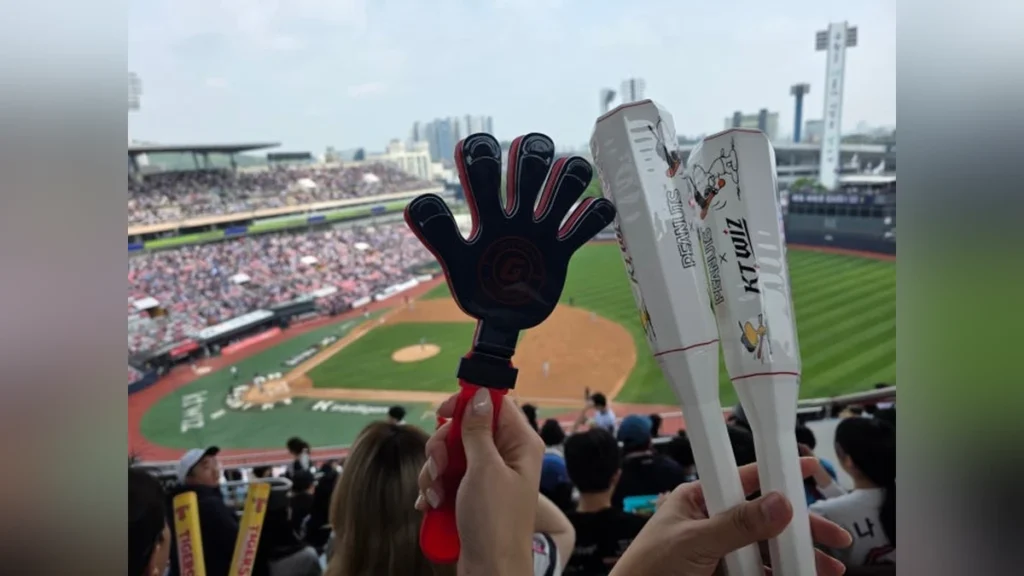
If there is a single image most people associate with Korean baseball cheering culture, it is this: thousands of fans banging two long inflatable plastic sticks together in perfect unison, creating a thunderous collective clapping sound that fills the entire stadium.
These are called 응원봉 (eung-won-bong) — cheer sticks, commonly known internationally as thunder sticks or bang-bang sticks. They are sold at every KBO stadium, usually near the entrance or at vendor carts around the concourse. They come in your team’s colors and they cost almost nothing — typically a few thousand won for a pair.
The thunder sticks are not optional if you want the full Korean baseball cheering culture experience. When the entire fan section is banging their sticks together in the same rhythm at the same moment, the sound is physical — you feel it as much as hear it. It turns passive watching into active participation in a way that is immediately, viscerally satisfying.
Technique, for what it’s worth: hold one stick in each hand and bang them together rather than against each other side-to-side. Match the rhythm of the crowd. When the cheer leader escalates, bang faster. When the team scores, raise them in the air. That’s it — that’s everything you need to know.
Pick up a pair on your way in. You will not regret it.
What to Eat and Drink at a Korean Baseball Game
This might be the section you were secretly most interested in, and honestly — fair enough. Korean baseball stadium food is spectacular, and it is a central part of why going to a KBO game feels so complete as an experience.
Fried Chicken
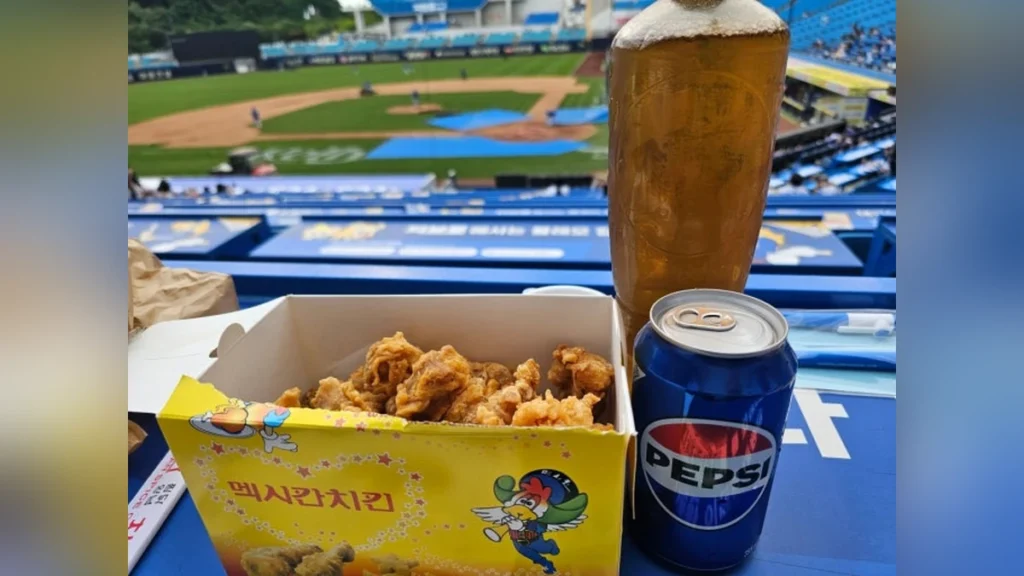
This is the headliner. Fried chicken at a Korean baseball game is not a side dish or a secondary snack — it is the main event. Korean stadium fried chicken is fresh, hot, properly seasoned, and served in generous portions. Ordering a box of fried chicken, cracking it open in your seat during the third inning, and eating it while the crowd chants around you is a Korean baseball tradition as essential as the thunder sticks.
Most KBO stadiums have in-stadium chicken delivery — you order from your seat and it arrives. The logistics of this still impress people who experience it for the first time.
Beer
Beer at a Korean baseball game comes in two forms. The first is the stadium vendor with a tank strapped to their back, dispensing draft beer directly into a cup right in front of you in the stands. The second, increasingly popular, is delivery beer ordered the same way as the chicken — you select a brand and quantity, and it arrives at your seat in a bag or a bucket.
Korean baseball stadiums are famously beer-friendly, and the combination of cold beer, fried chicken, and a game going well is one of the purest available expressions of a good time.
Cup Ramen
An underrated stadium staple. Hot instant noodles eaten from a paper cup while sitting in an outdoor stadium might sound basic, but on a cool evening it is genuinely perfect. Most KBO stadiums have hot water stations or convenience-style stands where cup ramen is available, and it remains one of the most beloved and budget-friendly stadium foods in the country.
Assorted Snacks and Street Food


Depending on the stadium, you’ll find everything from tteokbokki (spicy rice cakes) and hotteok (sweet pancakes) to corn dogs, squid, and grilled snacks. Korean stadiums are well-stocked with the same street food culture that makes Korean outdoor eating such a pleasure in any context. Walk the concourse before taking your seat and see what’s available — you’ll be spoiled for choice.
How to Pick Your Team and Your Seat
If this is your first KBO game, you might not have a team yet — and that’s perfectly fine. Here’s a quick way to think about it.
Picking a Team
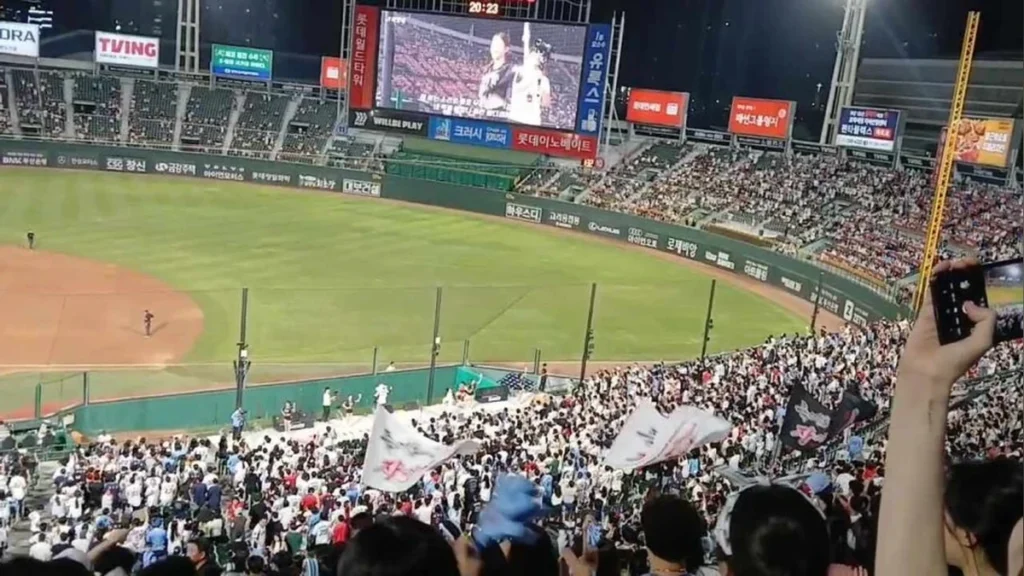
The easiest approach for visitors is simply to pick the home team and sit in their fan section. Most KBO stadiums are home games for a specific team, and the home team section is where the organized cheering, the cheer squad, and the thunder sticks action is concentrated. Picking the home team means you’re immediately in the thick of the best atmosphere.
If you’re in Seoul, the two main options are the LG Twins and the Doosan Bears, both of whom play at Jamsil Baseball Stadium — one of the most famous and beloved KBO venues. If you’re in Busan, the Lotte Giants have one of the most passionate fan cultures in the league. In Daegu, the Samsung Lions. In Incheon, the SSG Landers. Every team has its own fan identity and stadium character.
Choosing Your Seat
For the full Korean baseball cheering culture experience, sit in the outfield stands — specifically the section directly behind or near the cheer squad platform. This is where the organized cheering is loudest, where the thunder sticks density is highest, and where you will feel most immersed in the crowd energy.
The infield seats offer a better view of the actual game and tend to be a little calmer. They’re great if you’re with someone who genuinely wants to follow the baseball closely. But if your goal is atmosphere, outfield is the answer, every time.
Seats are assigned in Korean baseball stadiums, so check the seating map when purchasing tickets and aim for the outfield section on your team’s side.
What to Expect from the Crowd
Korean baseball crowds are enthusiastic, welcoming, and genuinely fun to be around — especially for visitors experiencing the culture for the first time.
Everyone participates. One of the most striking things about Korean baseball cheering culture is that the participation rate is very high. This isn’t a venue where half the crowd is looking at their phone while a few people cheer. The default is to join in, and the social pressure — gentle, but real — is toward participation rather than observation.
It is loud and it stays loud. Unlike sports crowds in many countries that peak during exciting moments and quiet down otherwise, a Korean baseball crowd maintains a remarkable baseline of noise and energy throughout the game. Innings don’t really have quiet periods. The chanting continues between pitches. The thunder sticks keep going. This is not tiring — it is energizing.
Strangers become temporary teammates. Something about the shared cheering experience in Korean baseball creates a fast, warm familiarity with the people around you. You’ll find yourself high-fiving strangers after a home run, making eye contact and laughing with the person next to you when a chant gets particularly funny, and sharing snacks with people you’ve never met. This communal quality is one of the most genuinely special things about the experience.
The vibe is celebratory regardless of the score. Even when the team is losing, Korean fan sections maintain their energy. The cheering doesn’t stop because things are going badly — if anything, it gets more determined. There is something deeply admirable about that.
Tips for First-Timers at a KBO Game
Here are the practical things that will make your first Korean baseball game genuinely great:
Buy tickets in advance. KBO games — especially weekend games and rivalry matchups — sell out regularly. Tickets are available through team websites and apps. Don’t show up and assume you’ll be able to walk in.
Arrive early and walk the concourse. Get there at least thirty minutes before first pitch. Walk around the stadium, see the food options, buy your thunder sticks at the entrance, and find your section while it’s still easy to navigate. The concourse pre-game atmosphere is part of the experience.
Sit on the home team’s side. As mentioned — this is where the organized cheering happens. The visiting team section exists, but it’s smaller and quieter. For your first game, go where the energy is.
Download the team’s chant playlist. Several KBO teams make their player chants available online. Listening to a few of them before the game means you’ll recognize the tunes when they start and be able to join in faster. Not essential, but a nice edge to have.
Embrace the chicken. Order it early. Stadium food can sell out or have lines during peak innings. Getting your fried chicken order in during the first or second inning means it arrives before the third and you can enjoy it during the heart of the game.
Don’t worry about understanding the game perfectly. Baseball has complex rules, but a Korean baseball game is fun even if you’re watching it as pure spectacle. Follow the energy of the crowd, cheer when everyone cheers, bang your sticks when everyone bangs, and let the experience tell you what’s happening.
Stay for the whole game. Korean baseball games typically run about three hours. The atmosphere builds as the game goes on, and the final innings of a close game in a stadium full of thunder sticks and chanting fans is an experience genuinely worth waiting for.
Final Thoughts
Korean baseball cheering culture is one of those experiences that is hard to fully describe until you’ve been inside it. The numbers — tens of thousands of people, hundreds of synchronized chants, waves of thunder sticks crashing together — don’t capture the feeling of being part of it. What the feeling actually is, is joy. Simple, collective, completely infectious joy.
You don’t need to be a baseball fan to love a KBO game. You don’t need to speak Korean to participate in the chants. You don’t need any prior experience with Korean sports culture to feel immediately at home in the outfield stands with a box of fried chicken in your lap and a pair of thunder sticks in your hands.
You just need to show up, look around, and let Korea do what Korea does best — make you feel like you’re exactly where you’re supposed to be, surrounded by people who are genuinely glad you came.
Go to a game. Bang the sticks. Eat the chicken. You’ll understand everything after the first inning.