Beyond the Trend: The Original Story of Dalgona Candy
Before It Became a Trend
For many people outside Korea, dalgona first appeared on a screen.
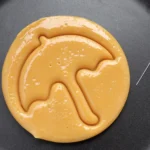
It looked fragile. Thin. Honey-colored. Stamped with a shape in the center. It was introduced as a game—break the candy without cracking the outline.
Suddenly, 달고나 (dalgona) seemed dramatic. Competitive. Even dangerous in its fictional context.
But long before it became internationally recognizable, it was something much smaller.
It was a coin in a child’s pocket.
“Want to Try?” (해볼래?)
Dalgona is made from only two main ingredients: sugar and baking soda.
Sugar is melted over heat until it turns amber. A small pinch of baking soda is added, and the mixture expands, becoming light and porous. It is quickly poured onto a flat surface and pressed thin. A metal stamp is then used to imprint a simple shape—usually a star, heart, umbrella, or circle.
That is all.
When a vendor hands a child a dalgona, sometimes they ask, “Want to try?” (해볼래?)
It means: try to separate the stamped shape without breaking it.
If successful, you might receive another piece for free.
The candy becomes a quiet test of patience.
The Taste of Burnt Sweetness
The literal taste of dalgona is simple: burnt sugar.
It is sweet, but not gently sweet. There is a slight bitterness at the edge, the taste of caramel pushed just before burning. The texture is airy and brittle. It cracks easily, scattering small golden fragments.
Some foreigners compare it to honeycomb toffee. That comparison is not wrong.
But in Korea, the taste carries something else.
It carries the smell of street gas burners. The metallic scrape of a ladle against a tin container. The brief moment when melted sugar turns from liquid to foam.
It carries waiting.
Because dalgona is not pre-packaged. You watch it being made. The process takes only a few minutes, but for a child, those minutes stretch. The sugar bubbles. The vendor moves quickly. Timing matters.
The candy exists only because someone stood there and waited.
Cheap, but Special
Dalgona was never expensive.
It was sold near elementary schools, in markets, sometimes by older vendors with portable carts. Children did not need permission to buy it. A small coin was enough.
Yet it did not feel ordinary.
Perhaps because it was not part of a meal. It was not filling. It dissolved too quickly. It left fingers sticky.
It was entirely unnecessary.
And because it was unnecessary, it felt like freedom.
There is something important about snacks that are not practical. They mark a space outside responsibility. A moment before homework. A pause between school and home.
Dalgona belonged to that narrow space.
The Shape in the Center
The stamped shape in dalgona is not decorative.
It creates tension.
Once the candy cools, you begin to scratch carefully along the outline. Some use a needle. Some use a toothpick. Some break it immediately and give up.
The surface looks solid, but it fractures easily. One wrong movement, and the entire piece splits.
There is no strategy guaranteed to work. Only steady hands.
For many Korean adults, the memory of breaking the shape too quickly remains vivid. The brief disappointment. The embarrassment if friends succeeded.
It was a small competition, but it felt serious at the time.
A Name That Means “Sweet”
The word 달고나 comes from 달다, meaning “to be sweet.”
But interestingly, many older Koreans remember calling it something else: 뽑기 (ppopgi), meaning “to pick out” or “to pull.”
The older name emphasized the action. The new name emphasizes the taste.
That shift is subtle.
Language changes with memory. What was once a game becomes a flavor.
Rediscovery
For a while, dalgona nearly disappeared from everyday visibility. Convenience stores replaced street vendors. Packaged snacks became more common. Hygiene standards tightened. The small gas burners and open sugar melting felt outdated.
Then, suddenly, dalgona returned to public attention.
Television dramas and global streaming shows featured it. Social media revived it. Cafés began selling “dalgona coffee,” a whipped drink inspired by the candy’s texture and color.
But for many Koreans, this rediscovery felt slightly strange.
Because dalgona was never glamorous.
It was slightly dusty. Slightly uneven. Made outdoors. Vulnerable to humidity. It melted in the rain.
It belonged to sidewalks, not screens.
The Sound of Cracking
If you hold dalgona close to your ear and press lightly, you can hear a faint cracking sound before it breaks completely.
It is delicate.
There is something fitting about that fragility. Dalgona does not last long. It cannot be stored for days. It absorbs moisture and softens.
It resists permanence.
Perhaps that is why it remains tied to childhood.
Childhood itself feels like something airy and brittle when remembered later. Sweet, slightly burnt at the edges, easily broken in recollection.
After It’s Gone
Once eaten, dalgona leaves no trace except a faint stickiness on your fingers.
You might lick the sugar from your thumb. You might brush crumbs from your uniform.
Then you walk home.
It does not anchor a meal. It does not change your hunger. It does not require reflection.
It simply interrupts the day.
And then the interruption ends.