Nampo-dong Kkangtong Night Market: What to Eat and How to Visit
Why Is It Called “Kkangtong”?
In Busan, when people say “Let’s go to Nampo,” they often mean one area in particular.
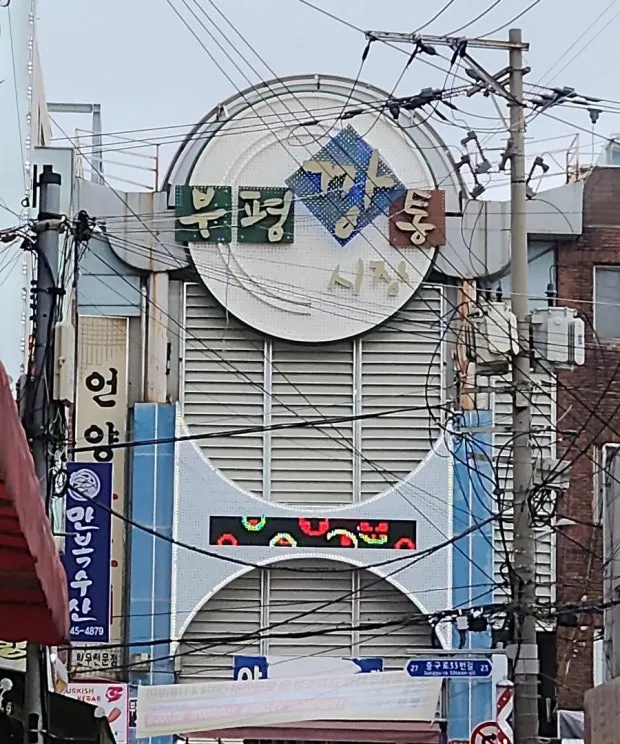
Kkangtong Night Market.
The name sounds unusual. “Kkangtong” (깡통) literally means “tin can.”
The market earned this nickname after the Korean War, when imported canned goods—especially from the U.S. military—were sold in the nearby traditional market area. What once signaled scarcity and foreign goods eventually became a permanent name.
The official name is tied to Gukje Market, but most locals still say “깡통시장.”
The word carries history.
From Day Market to Night Market
Originally, this area functioned as a traditional daytime market.
In 2013, Busan officially launched the Kkangtong Night Market as a designated night street food zone. Stalls were organized, lighting was added, and operating hours extended into the evening.
The shift reflected something broader in Korean culture.
Night became a time for leisure.
Food moved outdoors.
The market did not replace the old one.
It layered itself on top.
How to Get There
The market is located in Nampo-dong, Jung-gu, Busan.
By Subway
- Busan Metro Line 1 → Jagalchi Station (Exit 7)
- Busan Metro Line 1 → Nampo Station (Exit 1)
Both stations are within walking distance.
The walk itself passes through busy shopping streets and toward BIFF Square, another well-known area filled with street snacks and movie references.
You move through neon and storefronts before reaching the market lights.
What to Eat


Unlike older traditional markets focused on raw ingredients, Kkangtong Night Market specializes in ready-to-eat street food.
You will see:
- Grilled lobster with cheese
- Steak cubes on skewers
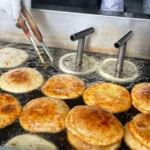
- Hotteok stuffed with seeds and syrup
- Fried dumplings
- Tornado potatoes
- International fusion snacks
The food is visual.
Cheese stretches. Flames rise from grills. Sauces are poured dramatically.
This is not quiet dining.
It is performance.
The Crowd
The market grows denser as the evening deepens.
Tourists gather with cameras. Students walk in groups. Families share trays of food.
You stand while eating.
Plastic tables line certain areas, but much of the experience involves holding skewers and navigating through people.
It is close. It is loud. It smells of oil and sugar.
The noise is part of it.
The Layered Surroundings
Kkangtong Night Market is not isolated.
Within walking distance are:
- Jagalchi Market — known for seafood
- Gukje Market — traditional goods and clothing
- BIFF Square — linked to the Busan International Film Festival
This clustering matters.
Nampo-dong is one of Busan’s older commercial districts. The streets feel narrower than in newer coastal areas like Haeundae.
History compresses here.
You feel it in the buildings, in the signage, in the uneven pavements.
Night Market Culture in Korea
Unlike some Southeast Asian cities where night markets are centuries old, Korea’s formal night markets are relatively recent institutional creations.
They are structured, regulated, and often curated.
Kkangtong Night Market reflects this modern organization. Stalls are assigned. Operating hours are defined. Hygiene standards are monitored.
Spontaneity exists, but within boundaries.
What It Feels Like
The market is bright.
LED signs reflect on stainless steel counters. Steam rises into cool evening air. People queue in lines that curve into one another.
You eat while standing, often without cutlery.
It is not refined.
It is immediate.
The experience is less about a single unforgettable dish and more about accumulation.
One skewer.
Then another.
Then something sweet.
You do not sit down for long.
You circulate.
After the Food
When you leave the market and step toward the main street, the lights thin out.
You might continue walking toward Jagalchi or back toward the subway.
Your hands may still smell faintly of sauce.
Kkangtong Night Market is not subtle.
It does not pretend to be traditional in an untouched way.
It is old history wrapped in modern appetite.
In Nampo-dong, night is not the end of business.
It is the beginning of it.