Hotteok: Korea’s Winter Street Pancake Explained
The Sound Before the Taste
You usually hear hotteok before you see it.
The oil sizzles.
The dough presses flat against metal.
Sugar begins to melt inside.
“Hotteok.” (호떡)
In English, it is often translated as “Korean sweet pancake.” The translation is technically correct, but it does not carry the season.
Hotteok belongs to winter.
Not officially. But emotionally.
What Hotteok Literally Is
Hotteok is a yeast-based dough filled with brown sugar, cinnamon, and chopped nuts, then flattened and cooked on a griddle with oil.
The outside becomes crisp and slightly chewy. The inside liquefies into a thick syrup.
When you tear it open, steam escapes first.
Then sweetness.
It is simple.
Flour. Sugar. Oil.
But timing is everything. Undercook it, and the dough feels raw. Overcook it, and the sugar hardens too much.
Street vendors press each one carefully with a metal tool, rotating it slightly so the filling spreads evenly.
It is repetitive work.
Eating It on the Street
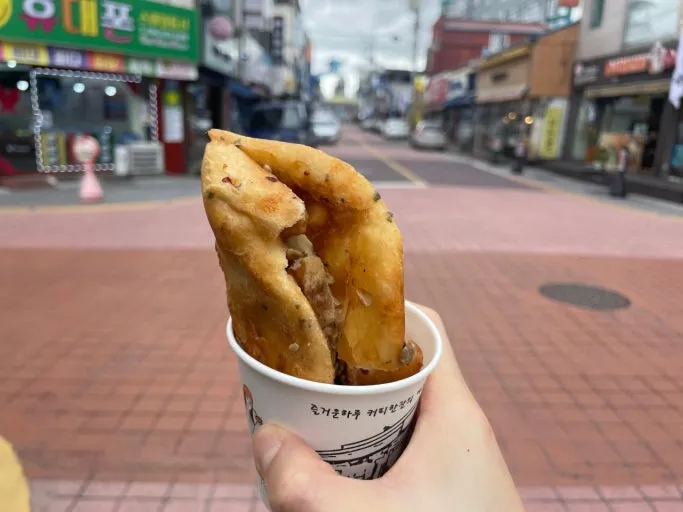
Hotteok is rarely eaten seated at a table.
You stand near the stall. You hold a small paper cup or folded napkin. You bite cautiously because the syrup inside is hotter than expected.
Someone usually says, “조심해, 뜨거워.” (“Be careful, it’s hot.”)
That warning is part of the ritual.
The sweetness is immediate, but the heat forces patience.
You wait a few seconds between bites.
Winter air cools the surface while the center remains molten.
Why Winter?
Hotteok is sold year-round in some places, but its presence intensifies when temperatures drop.
In cold weather, the warmth matters.
Korean winter street culture often includes foods that are held in the hands: roasted chestnuts, fish cake skewers in broth, steamed buns.
Hotteok fits this pattern.
You warm your fingers first.
Then your mouth.
The Busan Variation
In Busan, particularly around BIFF Square, a variation known as “seed hotteok” (씨앗호떡) became famous.
Instead of only brown sugar and nuts, this version includes a generous mix of sunflower seeds, pumpkin seeds, and other grains.
The texture shifts.
It becomes heavier, more layered, less purely syrup-driven.
People line up specifically for this version.
The filling spills out visibly when cut.
It looks almost overfilled.
Street Food and Labor
Hotteok stalls often appear temporary—small carts with propane tanks and flat griddles.
But the labor is consistent.
Dough must be prepared in advance. Portions are shaped by hand. Each piece is filled and sealed individually.
Unlike factory-made snacks, hotteok cannot be rushed entirely.
You wait while it cooks.
There is no shortcut for melting sugar inside dough.
Not Just a Snack
For many Koreans, hotteok carries childhood associations.
After-school purchases. Winter festivals. Parents handing over coins to a vendor.
It is inexpensive, accessible, and filling.
It does not belong to celebrations.
It belongs to ordinary days.
That ordinariness makes it durable.
The Texture Koreans Describe
Koreans often describe good hotteok as “겉바속촉” — crispy outside, soft inside.
But the phrase does not fully capture the syrup center.
The center is not simply soft.
It flows.
If you tilt the torn half slightly, the sugar mixture moves slowly.
Too little syrup, and it feels disappointing.
Too much, and it becomes difficult to hold.
Balance defines quality.
After the Last Bite
When you finish a hotteok, your fingers may be slightly sticky.
The paper cup is lightly soaked with oil.
The sweetness lingers.
Hotteok does not pretend to be refined.
It is greasy. It is sugary. It is eaten standing.
And yet, every winter, lines form again.
Because the experience is not only about taste.
It is about temperature, timing, and repetition.
The vendor presses another circle of dough flat.
The oil sizzles again.
You hear it before you decide to buy.