The Quiet Flavor of Pyongyang Naengmyeon
“It Tastes Like Nothing.”
This is a common first reaction.
When someone tries Pyongyang naengmyeon for the first time, they often expect intensity. Spicy broth. Strong vinegar. Clear sweetness.
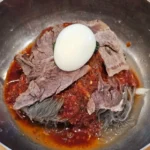
Instead, they receive a large metal bowl filled with pale broth, thin buckwheat noodles, a few slices of beef, half a boiled egg, and sometimes cucumber or radish.
The broth looks almost transparent.
They take a sip.
And then they pause.
“Is this… it?”
The Literal Meaning
“Naengmyeon” (냉면) means “cold noodles.”
“Pyongyang” (평양) refers to the capital of North Korea.
Historically, this dish originates from the northern regions of the Korean peninsula. The colder climate made buckwheat a practical grain. Broth was often made from beef, sometimes mixed with dongchimi (radish water kimchi brine), creating a clean and lightly tangy base.
The flavor profile was never meant to be loud.
It was built for winter originally—not summer.
That surprises many people.
The Taste That Refuses Drama
The broth of Pyongyang naengmyeon is subtle.
It is lightly savory, slightly cool, faintly tangy. The buckwheat noodles are softer and more fragile than the chewy noodles found in other Korean cold noodle dishes.
There is no aggressive spice.
In fact, adding too much vinegar or mustard before tasting is sometimes quietly frowned upon in traditional restaurants.
You are expected to try it as it is first.
There is a belief that the broth should be understood before being adjusted.
Why Koreans Defend It
Among Koreans, Pyongyang naengmyeon inspires unusual loyalty.
Some people crave it intensely. Others claim they did not understand it at first but grew to appreciate it later.
It is rarely love at first bite.
The attachment develops slowly.
Part of this loyalty may come from what the dish represents. Pyongyang naengmyeon is associated with North Korean culinary tradition, with migration, with separation after the Korean War.
Restaurants in Seoul that specialize in it often trace their origins to families who moved south decades ago.
When people line up for a bowl, they are not only chasing flavor.
They are participating in memory.
Texture and Temperature
The noodles are usually made with a high percentage of buckwheat. That makes them softer and more breakable than wheat-based noodles.
Servers often bring scissors to cut the long strands.
The broth is cold but not icy. The temperature is carefully controlled—too cold, and the flavor disappears; too warm, and it feels wrong.
This balance requires precision.
Yet the final result still appears simple.
A Dish That Tests Patience
Korean cuisine includes bold flavors—fermented chili paste, garlic, kimchi, grilled meats.
Against that backdrop, Pyongyang naengmyeon feels restrained.
It asks the eater to slow down.
You sip the broth.
You chew the noodles.
You notice the faint buckwheat aroma.
Nothing explodes on the tongue.
Instead, the flavor lingers quietly.
Some describe it as “clean.” Others say “plain.”
Both words can mean different things depending on expectation.
The Division Between Pyongyang and Hamhung
There is another well-known cold noodle style: Hamhung naengmyeon.
Hamhung naengmyeon is spicier, often served mixed with red chili sauce and raw fish or seafood. Its flavor is sharper, more immediate.
The contrast between these two styles often becomes a personality question.
Are you someone who prefers clarity?
Or someone who prefers impact?
The debate is ongoing.
Eating It Properly?
There is no strict rule, but tradition suggests:
- Taste the broth first without adding anything.
- Mix gently if mustard or vinegar is added.
- Do not rush.
But in reality, people eat according to habit.
Some pour vinegar immediately. Some stir vigorously. Some drink the broth entirely; others leave it behind.
Restaurants rarely correct you.
They simply watch.
Why It Endures
Pyongyang naengmyeon does not compete for attention.
It does not photograph dramatically compared to colorful Korean dishes. It looks almost austere.
Yet in Seoul, some of the most respected restaurants serving it have decades-long histories and loyal customers.
The bowl arrives cold and quiet.
You lean over it.
At first, it feels incomplete.
Then, somewhere between the third and fifth bite, something shifts.
The flavor is still soft.
But it no longer feels empty.
In Korea, that moment—when subtlety becomes satisfying—is often considered maturity of taste.
Pyongyang naengmyeon does not chase you.
It waits.