Why Tipping is Uncommon in Korea
Why Koreans Do Not Accept Tips
For many visitors, the moment arrives unexpectedly.
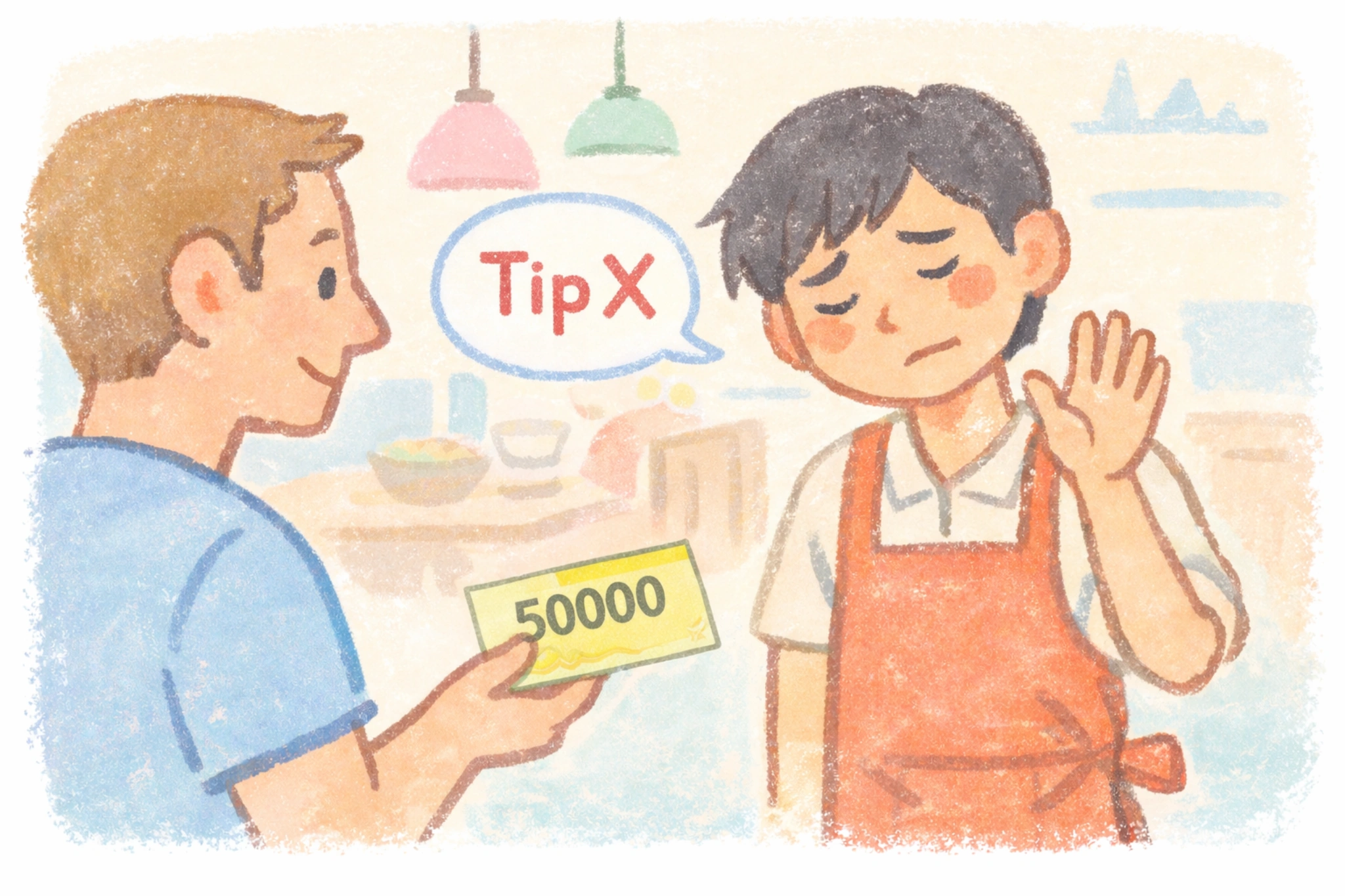
The meal is over. The service was attentive. Someone stood nearby, ready to clear the table or bring the receipt. You reach for your wallet and add a little extra, just to be polite. Just to say thank you.
And then the hand freezes mid-air.
The staff member shakes their head. Sometimes gently. Sometimes firmly.
“No, it’s okay.”
The refusal can feel awkward. Even embarrassing.
In some countries, refusing a tip would be rude. In Korea, accepting one can feel stranger.
The Literal Meaning of a Tip
A tip, in its simplest sense, is extra money.
Money given voluntarily, beyond the listed price.
A personal gesture layered on top of a transaction.
There is no Korean word that carries this meaning cleanly.
The borrowed term “tip” (팁) exists, but it feels foreign, technical, and slightly artificial. It is used in hotels catering to foreigners, or in conversations about overseas travel. Not in ordinary life.
When something has no settled word, it often has no settled place.
How Service Is Actually Given
In Korea, service is not framed as something earned individually.
It is not a performance that fluctuates by mood or customer generosity.
Service is assumed.
The food should arrive hot.
The table should be clean.
Questions should be answered clearly.
Mistakes should be corrected without argument.
This is not considered exceptional behavior. It is simply the job.
When Koreans talk about good service, they rarely mention friendliness. They talk about smoothness. Speed. Accuracy. Whether anything felt “uncomfortable” (불편했는지).
If nothing felt uncomfortable, the service was good enough.
When Extra Money Becomes a Problem
Offering a tip introduces a new layer to the interaction.
It personalizes what was meant to remain neutral.
Extra money suggests that something exceeded expectations.
But in Korea, meeting expectations is the expectation.
Accepting a tip can feel like admitting that the standard service was not included in the price. That the system itself was incomplete.
For the worker, it can also feel like being singled out.
Why me, and not the coworker in the kitchen?
Why now, and not every customer?
What was meant as gratitude becomes imbalance.
Common Misunderstandings
Foreigners often interpret refusal as false modesty.
A performance of politeness, waiting to be persuaded.
But most refusals are final.
There is also the assumption that refusing tips means workers are well paid. This is not always true. Low wages exist. Long hours exist. Service labor is not romanticized.
The absence of tipping is not proof of fairness.
It is proof of structure.
Korean discomfort with tips does not come from pride alone. It comes from a belief that compensation should not depend on the mood or background of the customer.
The Social Weight of Money
In Korean culture, money is rarely neutral.
It carries hierarchy, obligation, and memory.
Giving money directly can feel heavier than giving words.
It creates a silent question: what is this for?
In close relationships, money is often wrapped in excuses.
“Just in case.”
“For snacks.”
“Because it’s cold.”
In public interactions, that wrapping is missing.
A tip arrives exposed. It asks to be interpreted.
Service as a Role, Not a Relationship
Service workers in Korea often keep emotional distance.
Not because they are cold, but because closeness implies responsibility.
If a server becomes “nice,” what happens next time?
If they accept extra money, are they now indebted?
By refusing tips, the relationship stays contained.
Customer and staff remain in their roles.
Nothing spills over.
This containment protects both sides.
Historical Background, Briefly
Modern Korean service culture developed alongside rapid industrialization. Efficiency mattered. Uniformity mattered. Clear pricing mattered.
During periods when money was scarce, fairness meant predictability. You paid the price on the menu. Nothing more. Nothing less.
Tipping, with its ambiguity, did not fit easily.
Over time, the absence of tipping became normal.
Normal became correct.
Correct became moral.
Exceptions That Prove the Rule
There are places where tipping appears: luxury hotels, tour guides working with foreign clients, international airports.
Even there, it often feels procedural.
Envelopes. Discretion. Clear signals.
The moment tipping requires explanation, it stops being natural.
The Emotional Undercurrent
For some Koreans, accepting a tip feels like accepting judgment.
Was I good enough?
Was I better than expected?
There is relief in not having to ask these questions.
Service is given the same way every time, to everyone.
Or at least, that is the ideal.
A Quiet Ending
When a Korean refuses a tip, it is rarely dramatic.
The bill is returned. The change is exact.
The moment passes.
No lesson is offered.
No offense is intended.
The money simply does not belong there.