Why Koreans Avoid Direct Eye Contact
Why the Eyes Often Look Away
For many people visiting Korea, one moment feels quietly confusing.
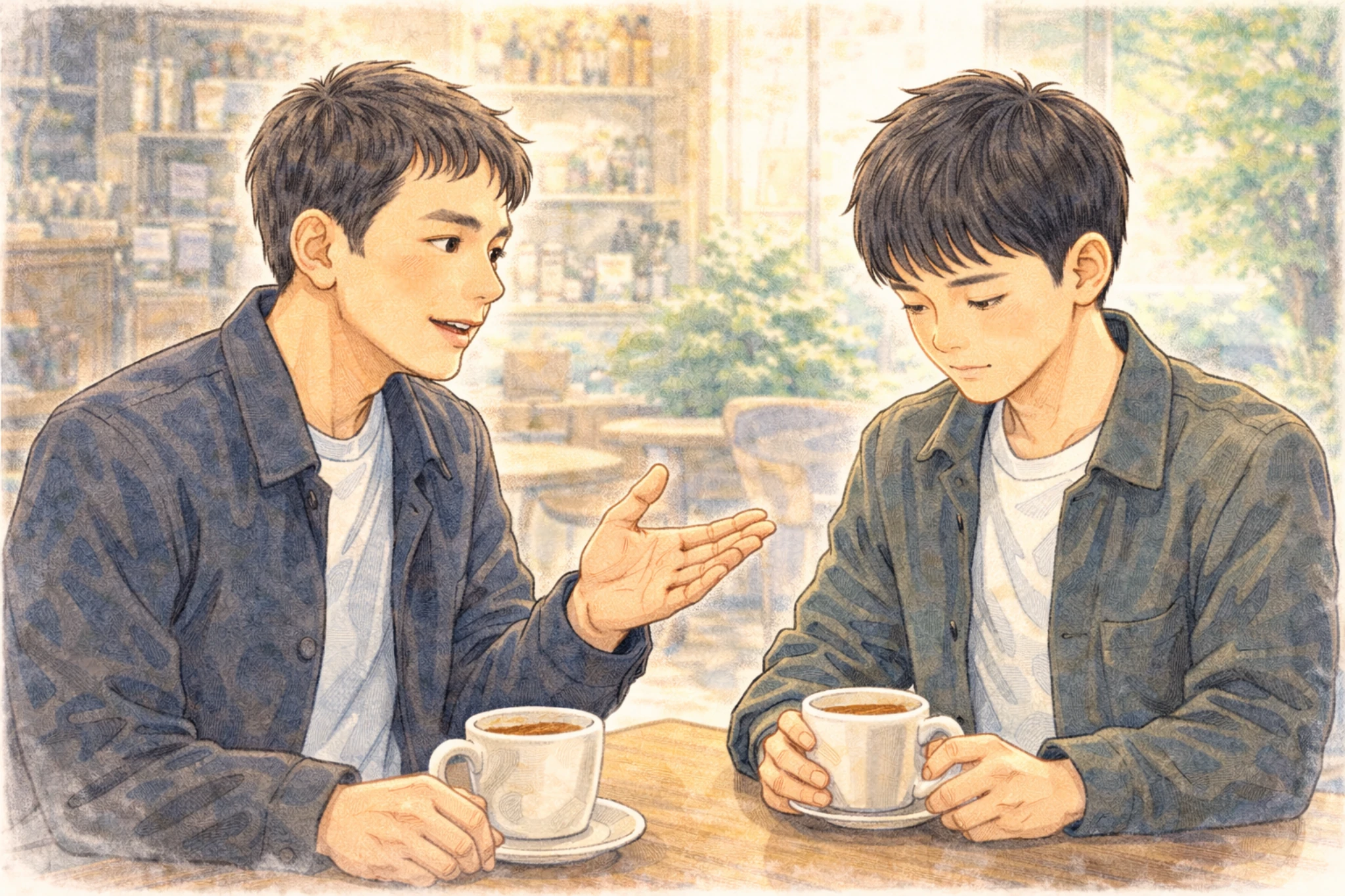
You are speaking. The words are polite, the tone is calm, but the other person’s eyes drift away. Not dramatically. Not in a way that signals boredom or avoidance. Just slightly to the side. Down. Anywhere but directly at you.
It can feel unsettling. In some cultures, eye contact is proof of sincerity. Looking away suggests discomfort, evasion, or even disrespect. So when Koreans do it—often, repeatedly, even in serious conversations—it raises an unspoken question: Why aren’t they looking at me?
The answer is not simple. It is also not fully intentional.
“Looking at the Eyes” (눈을 마주보다)
Literally, “to make eyes meet” (눈을 마주보다) means exactly what it says. Two people’s gazes align. In Korean, this phrase already carries a sense of intensity. It implies a moment that matters.
Eye contact is not neutral in Korean social life. It has weight. It can feel loud.
Because of that, Koreans do not use it casually.
How It Appears in Daily Conversation
In everyday conversations, Koreans often look away while speaking, then briefly glance back while listening. The gaze moves, but rarely settles. This is especially noticeable in conversations with elders, supervisors, teachers, or anyone perceived as socially “above.”
The absence of steady eye contact does not signal dishonesty. In fact, maintaining strong eye contact while speaking—especially to someone older—can feel aggressive. It can appear as if one is asserting themselves too strongly, placing their presence forward rather than keeping it restrained.
So the eyes drift. The voice remains steady. The message is delivered.
This is not something most Koreans consciously decide. It is learned early, reinforced quietly, and rarely explained.
A Common Misunderstanding
Outsiders often read this behavior as insecurity or lack of confidence. Sometimes as evasiveness. In professional settings, it can be misinterpreted as disengagement.
But in Korea, confidence is not performed through the eyes. It is shown through restraint, tone, and timing. Saying the right thing at the right moment matters more than holding someone’s gaze.
In fact, too much eye contact can feel like a challenge. It can disrupt the balance of the interaction, making the other person uncomfortable without a clear reason.
Nothing obvious has gone wrong.
But something feels off.
Hierarchy and the Direction of the Gaze
Korean society has long been shaped by hierarchy—age, position, experience. Even as social structures modernize, this awareness remains embedded in daily interaction.
Looking directly into someone’s eyes, especially while speaking, can feel like crossing an invisible line. It suggests equality, or worse, confrontation. So the eyes lower, not out of submission, but out of social calibration.
Children learn this early. They are told not to “stare” at adults. Not because it is rude in the Western sense, but because it disrupts the expected flow of respect.
The habit stays.
Silence Between Glances
Eye contact in Korea often appears in brief moments. A quick look to acknowledge understanding. A glance to confirm attention. Then the eyes move away again.
These pauses are not empty. They allow space. They reduce pressure.
Constant eye contact demands response. It pulls the other person forward. By avoiding it, Koreans often create a softer conversational rhythm, where neither party feels forced to react too strongly.
This can feel distant to outsiders. But within Korea, it often feels considerate.
Emotional Conversations Feel Different
When conversations become emotional, the avoidance of eye contact can deepen. During apologies, confessions, or expressions of gratitude, looking directly at someone can feel overwhelming.
Lowering the gaze creates emotional safety. It allows words to exist without requiring immediate emotional mirroring. Tears do not need to be met. Reactions do not need to be shared.
The speaker can finish what they need to say.
Not a Rule, Not a Choice
It is important to say this clearly: Koreans are not following a rulebook. Many Koreans are not even aware they are doing this until it is pointed out.
Habits like these live in the body. In posture. In where the eyes naturally go when speaking.
When Koreans do hold eye contact—during arguments, intense discussions, or moments of strong conviction—it feels deliberate. The room changes. The silence sharpens.
Because eye contact was absent before, its presence becomes meaningful.
When Koreans Do Look Directly
There are moments when Koreans hold eye contact without hesitation. Among close friends. Between equals in relaxed settings. In moments of confrontation.
Here, eye contact does not signal politeness. It signals honesty, intensity, or emotional closeness. It says, This matters.
Which is exactly why it is not used lightly.
An Unfinished Gesture
So when a Korean looks away while speaking to you, it is not because you are unimportant. Often, it is the opposite. The space created by the averted gaze is a form of care. A way to keep the interaction smooth, controlled, and respectful.
Not everything in conversation is meant to be shared directly. Some things are carried quietly, in habits so ordinary they disappear.
The eyes follow that same logic.
They move away.
And the conversation continues.