Walking Through Gwanghwamun: Past and Present
A Gate That Faces the City
In the center of Seoul, there is a wide open space where traffic, history, and politics overlap.
That place is Gwanghwamun.
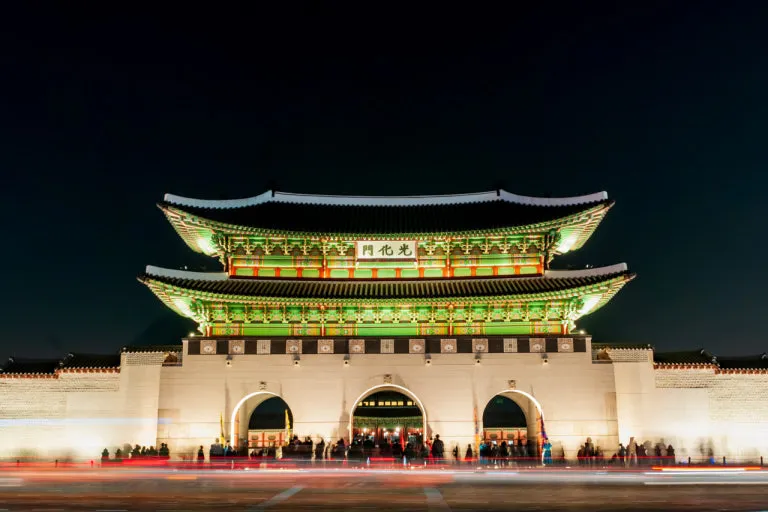
Literally, “Gwanghwamun” (광화문) means “Gate of Gwanghwa.” It is the main gate of Gyeongbokgung Palace, the principal royal palace of the Joseon Dynasty.
But today, the word refers to more than a gate.
It refers to an axis.
The Historical Core
Gwanghwamun Gate was originally built in 1395 during the early Joseon Dynasty. It stood as the symbolic entrance to royal authority.
Over centuries, it was destroyed, relocated, reconstructed, and restored.
Japanese colonial occupation altered its structure and positioning. The Korean War damaged it further. Modern restoration efforts attempted to bring it closer to its original form.
So when you look at the gate today, you are not seeing something untouched.
You are seeing something rebuilt repeatedly.
The wood and stone hold interruption.
The Square
In front of the gate lies Gwanghwamun Square.
Wide, open, and deliberately designed, the square is lined with statues of two figures central to Korean historical memory:
- King Sejong the Great
- Yi Sun-sin
King Sejong is associated with the creation of Hangul, the Korean alphabet.
Admiral Yi is remembered for his naval victories against Japanese invasions in the 16th century.
Their statues face south.
Behind them, modern office buildings rise.
In front of them, traffic moves continuously.
Past and present remain in direct view of each other.
A Place of Protest
For many Koreans, Gwanghwamun is not only historical.
It is political.
Major public demonstrations have taken place here. Candlelight vigils. Labor rallies. Pro-democracy gatherings.
The square’s openness allows crowds to assemble in large numbers. It has become one of the primary civic stages in South Korea.
If you say, “We’re going to Gwanghwamun,” the meaning can depend on the context.
Sightseeing.
Work.
Protest.
The space absorbs all three.
How to Get There
The most direct way is via subway:
- Seoul Subway Line 5 → Gwanghwamun Station
- Seoul Subway Line 3 → Gyeongbokgung Station
Both exits lead toward the same axis: palace, gate, square.
From the station stairs, the city opens suddenly into breadth.
What to See Nearby
Gyeongbokgung Palace
Walking through Gwanghwamun Gate leads directly into the palace complex. Courtyards expand behind it. Mountains frame the background.
Cheonggyecheon Stream
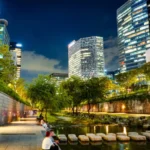
A short walk south brings you to Cheonggyecheon, an urban stream restored in the 2000s. Office workers eat lunch along its edges.
Government Buildings
Several major government offices are located around the square. It is not unusual to see police buses parked during planned demonstrations.
The neighborhood blends tourism and administration seamlessly.
Morning and Night
In the morning, Gwanghwamun feels formal.
Office workers walk quickly. Tour groups gather in front of the statues. The palace gates open with scheduled ceremonies.
At night, the atmosphere softens. The gate is illuminated. Couples sit along the square’s edges. The statues cast longer shadows.
It is possible to stand in the center and feel both exposed and grounded.
The space is wide enough that silence can exist even with traffic nearby.
What Gwanghwamun Represents
For Koreans, Gwanghwamun is layered.
It represents royal authority.
It represents colonial disruption.
It represents democratization.
It represents public voice.
Few places in Seoul compress so much history into a single line of sight.
Stand facing north:
You see the gate, the palace, the mountain behind.
Turn south:
You see modern Seoul stretching outward.
The alignment is intentional.
It suggests continuity.
But history here has never been uninterrupted.
Gwanghwamun remains steady in name.
The meaning shifts depending on who is standing there.