The Dynamics of Bill Payment in Korean Culture
The Awkward Moment at the End of the Meal
The food is gone.
The table is quiet for a second.
Then someone reaches for the bill.
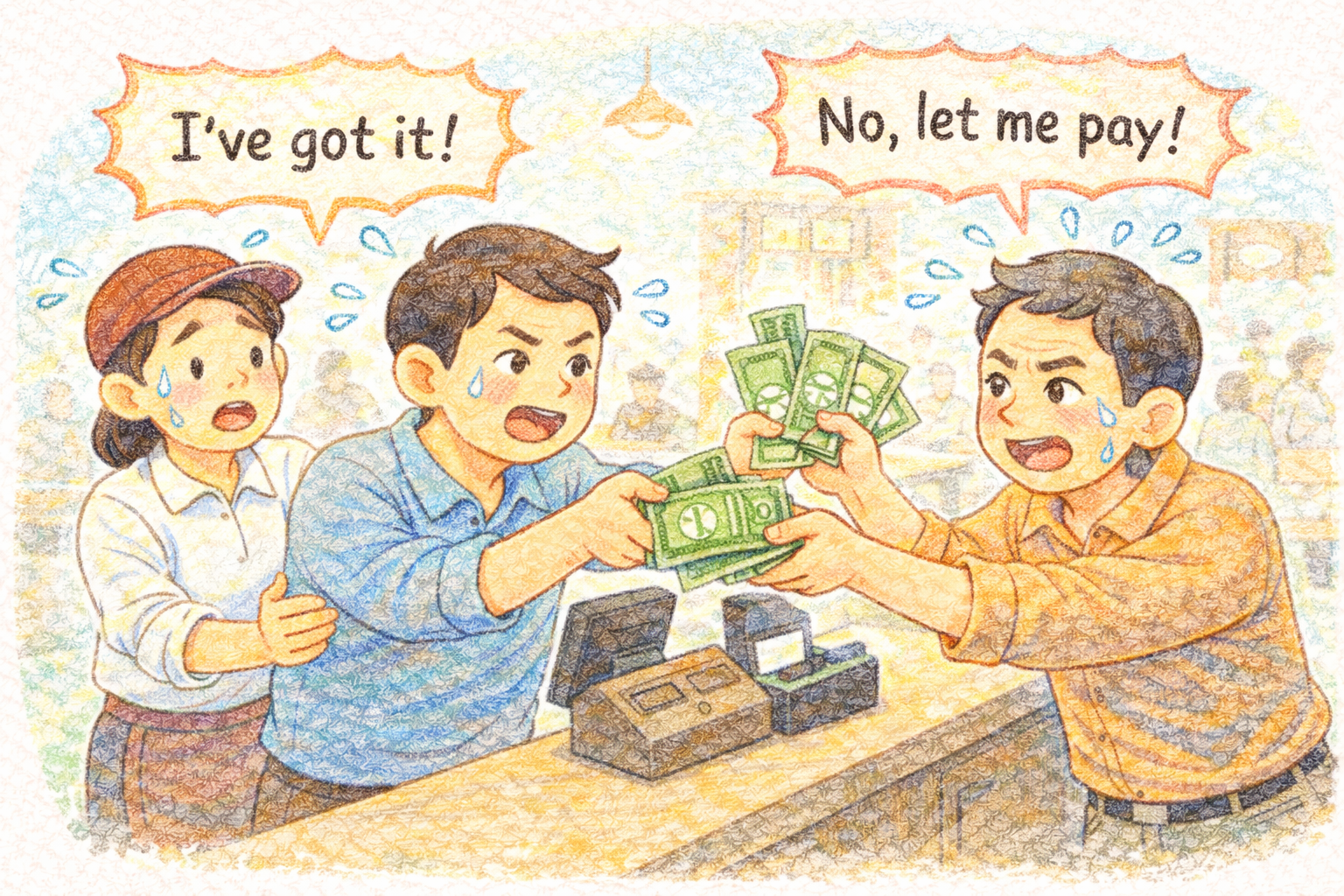
Immediately, another hand moves faster.
“No, I’ll pay.” (내가 낼게)
“No, no, I will.” (아니야, 내가 낼게)
Voices overlap. Hands block each other. The cashier waits, already familiar with this scene.
For many visitors, this moment feels confusing, even uncomfortable. Why not just split it? Why does paying become a small struggle?
In Korea, the tension around the bill rarely has much to do with money.
What Paying Literally Means
At its simplest level, paying means covering the cost of the meal.
But socially, paying often carries another meaning: I take responsibility for this time we spent together.
The person who pays is not just closing a transaction. They are marking the relationship, even if only slightly.
That is why the moment feels heavier than it looks.
What Actually Happens in Real Life
Despite the dramatic back-and-forth, the outcome is often predictable.
The older person pays.
The senior pays.
The inviter pays.
Sometimes the decision is made before anyone sits down. Sometimes it follows an unspoken hierarchy everyone already understands.
The argument is not about uncertainty. It is about confirming roles one more time, out loud.
Why Splitting the Bill Feels Strange
Splitting the bill sounds fair. Logical. Clean.
But in many Korean settings, it can feel emotionally distant.
Dividing the cost too neatly can signal that the relationship itself is being divided. Each person retreats into their own portion, their own responsibility, their own boundary.
Paying for the whole table avoids that separation. It keeps the group intact, even if only symbolically.
Not a Performance for Generosity
From the outside, the scene can look like performative kindness.
But most Koreans do not experience it that way. The act is not meant to impress. It is meant to settle something quietly.
By paying, one person removes the discomfort of calculation for everyone else.
The relief matters more than the generosity.
Age, Position, and Invisible Order
Korean society is sensitive to order, even in casual spaces.
Age, workplace rank, and seniority don’t disappear at the dinner table. They soften, but they remain present.
If a younger person insists too strongly on paying, it can feel like stepping out of place. If an older person refuses to pay at all, it can feel neglectful.
The struggle over the bill is a brief negotiation of that order.
When Someone Insists Too Much
There is a point where insisting becomes uncomfortable.
If someone repeatedly tries to pay despite clear resistance, the mood can tighten. What began as politeness starts to feel like pressure.
That line is rarely spoken, but most people sense it. The goal is not to win. It is to show willingness, then allow the expected outcome to happen.
The Role of “Next Time”
Often, the conflict ends with a promise.
“I’ll get it next time.” (다음에 내가 살게)
This phrase is important. It pushes the exchange forward in time. It keeps the relationship open.
By accepting the meal now and promising the next one, balance is restored without immediate equality.
When People Quietly Let Someone Pay
Sometimes, no one argues.
Everyone knows one person will pay, so the others pause, hands still. This silence is not indifference. It is recognition.
Arguing would only disrupt what has already been decided.
Why It Can Feel Uncomfortable to Watch
For people from cultures where bills are split automatically, this moment can feel tense.
It looks inefficient. It delays departure. It creates noise.
But in Korea, this pause is doing social work. It smooths the edges of hierarchy, obligation, and closeness in a way that numbers alone cannot.
Money as a Medium, Not the Message
The amount rarely matters.
A cheap meal can still trigger the same exchange. An expensive one might pass without a word if roles are clear.
The bill is simply the final object on the table that forces everyone to acknowledge their position to one another.
When the Rule Breaks
Among close friends, habits change.
Younger people split more often. Apps make it easier. Some groups rotate payments without discussion.
But even then, someone often says, half-jokingly, “I’ll pay this time,” as if checking whether the old rhythm still exists.
What Is Really Being Protected
By fighting over the bill, Koreans are often protecting something quiet.
No one is being burdened.
No one is left calculating.
No one leaves feeling they took too much.
The struggle itself absorbs the discomfort, so the relationship doesn’t have to.
And once the payment is done, the moment disappears quickly. People stand up. Shoes go on. Conversation resumes.
The bill is gone. The relationship continues.