K-POP 2nd Generation Explained: Groups, Rivalries, Scandals, and the Era That Built Global K-POP
The second generation of K-pop was not simply a continuation of the idol system—it was the era that tested its limits, exposed its flaws, and proved its global potential.
Roughly spanning the mid-2000s to early 2010s, this period transformed K-pop from a fast-growing domestic industry into a structured cultural export.
It was defined by large-scale fandoms, fierce rivalries, overseas expansion, historic legal disputes, and the rise of idols as global pop figures.
Nearly every rule that governs K-pop today—contracts, promotions, fandom behavior, global strategy—can be traced back to this era.
The Industry Environment of the 2nd Generation
By the mid-2000s, South Korea had become one of the most digitally connected societies in the world.
High-speed internet allowed fans to gather in online communities, while television still controlled mainstream exposure.
Entertainment companies realized two critical facts:
- Idol groups could generate long-term revenue across albums, concerts, merchandise, and endorsements.
- K-pop’s visual and performance-driven format could overcome language barriers.
As a result, the idol system shifted from experimentation to industrial-scale production.
TVXQ: Redefining Scale and Overseas Success
Debuting in 2003, TVXQ became the symbol of second-generation ambition.
Activities & Achievements
- Achieved massive success in Korea before expanding aggressively into Japan
- Became one of the top-selling foreign artists in the Japanese market
- Headlined large-scale dome tours, setting benchmarks for future groups
TVXQ proved that a K-pop group could operate at the level of major Japanese pop acts.
The Contract Lawsuit (Turning Point)
In 2009, members filed a lawsuit challenging their long-term contracts.
The case exposed:
- Contracts exceeding a decade
- Limited revenue transparency
- Severe power imbalance between agencies and artists
The legal outcome directly influenced the creation of standardized idol contracts and permanently altered industry practices.
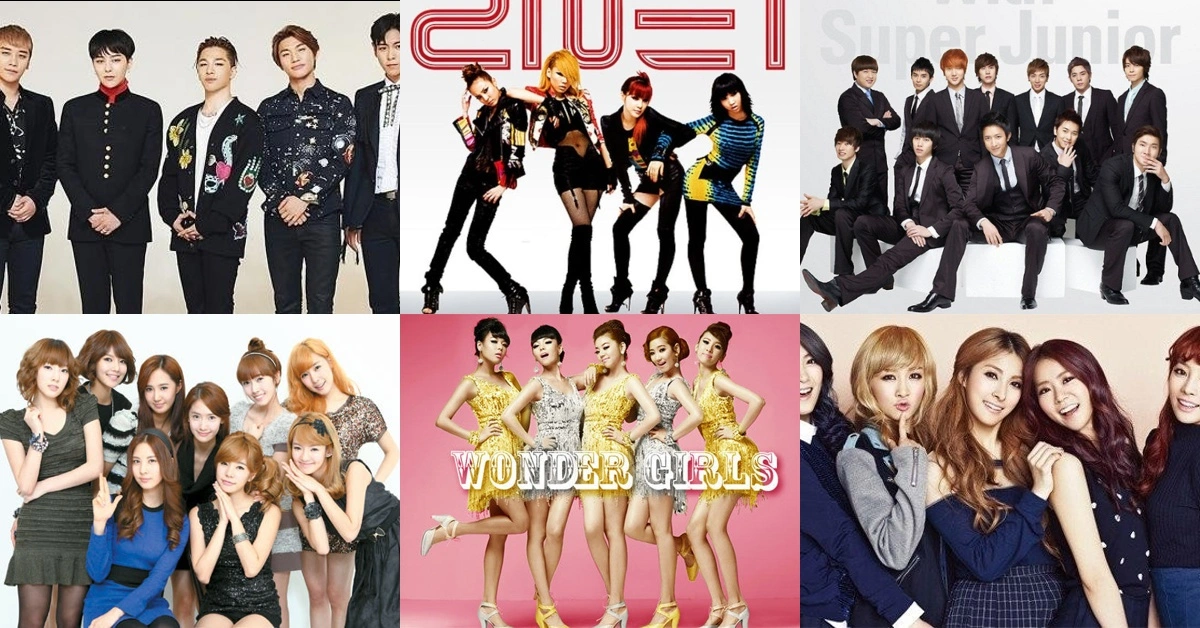
Super Junior: Experimentation Through Scale
Super Junior debuted with an unusually large lineup, challenging the idea that idol groups needed fixed membership.
Industry Innovation
- Introduced the sub-unit system, allowing localized promotions
- Targeted different markets and musical styles within one brand
Challenges & Issues
- Frequent member injuries and hiatuses
- Ongoing debate about group structure and sustainability
Despite instability, Super Junior became one of the most recognizable K-pop brands across Asia.
BIGBANG: Individuality and Artistic Shift
BIGBANG represented a major ideological shift in idol culture.
Musical & Cultural Impact
- Members actively participated in songwriting and production
- Blended hip-hop aesthetics with mainstream pop
- Influenced fashion trends beyond music
Public Perception
BIGBANG challenged the idea that idols must be interchangeable or tightly controlled.
This repositioned idols as artists rather than performers only.
Girls’ Generation: Defining the Modern Girl Group
Girls’ Generation became the most publicly recognizable girl group of the era.
Achievements
- Dominated charts and year-end award shows
- Achieved both fandom loyalty and general public support
- Became cultural icons through music, advertising, and television
Their success established the template for future girl groups balancing approachability and polish.
Girl Group Expansion and Competition
Beyond Girls’ Generation, the second generation saw explosive growth in girl groups.
- Wonder Girls achieved international exposure through U.S. promotions
- KARA became especially influential in Japan
- 2NE1 introduced a powerful, unconventional female image
These groups diversified the definition of femininity in K-pop.
Award Shows, Charts, and Fandom Warfare
Second-generation fandom culture reached unprecedented intensity.
- Fans organized mass album purchases
- Online voting determined awards
- Chart positions became symbolic victories
Award shows were not just celebrations—they were arenas of identity and loyalty.
Scandals, Hiatuses, and Public Pressure
As visibility increased, so did scrutiny.
- Dating rumors sparked public backlash
- Injuries led to long hiatuses
- Mental and physical exhaustion became visible issues
The era revealed the human cost of idol perfection.
Media Transition: Analog to Digital
The second generation existed between two worlds:
- Television-dominated promotion
- Early digital fan distribution
Fans uploaded performances, translated content, and spread K-pop internationally—often without official support.
This grassroots globalization set the stage for viral K-pop.
Why the 2nd Generation Was a Structural Turning Point
The second generation:
- Proved K-pop could scale globally
- Forced reforms in contracts and management
- Built the infrastructure for international fandoms
It was the era that made later worldwide success possible.
Transition Into the 3rd Generation
By the early 2010s, YouTube removed the final barrier.
K-pop no longer depended on regional broadcasters.
This marked the beginning of the third generation, where global audiences arrived instantly.