Cheonggyecheon Stream Seoul: History, Walks, and What It Means Today
A Stream Beneath the City
In the middle of Seoul, where traffic moves constantly and office towers line the streets, there is water.
It does not look ancient.
It does not look wild.
It looks intentional.
Cheonggyecheon runs for about 11 kilometers through downtown Seoul. Today, it is one of the city’s most familiar walking paths.
But for decades, it was hidden.
Before the Water Returned

Cheonggyecheon was originally a natural stream flowing through the old city.
Over time, especially during rapid industrialization in the mid-20th century, the stream became polluted. Eventually, it was covered with concrete. An elevated highway was built above it.
For many years, people drove over Cheonggyecheon without seeing it.
In the early 2000s, a major urban restoration project removed the highway and reopened the stream. Water was reintroduced. Walkways were built along both sides.
The transformation was dramatic.
Concrete was replaced with movement.
How to Get There
Cheonggyecheon stretches across central Seoul, so there is no single entrance.
Common access points include:
- Gwanghwamun Station
- Jonggak Station
- Euljiro 1(il)-ga Station
From street level, you descend stairs into a quieter space. The sound of traffic softens. The temperature drops slightly.
It feels like stepping down into another layer of the city.
What You See Along the Walk
At the western starting point stands a symbolic sculpture marking the beginning of the stream.
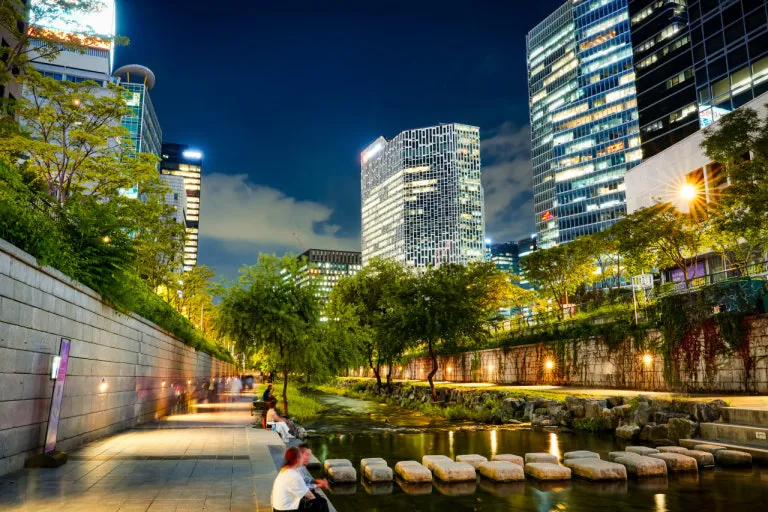
Further along, stepping stones allow visitors to cross shallow water. Office workers pause during lunch breaks. Couples sit on stone edges with takeaway coffee.
Bridges pass overhead at regular intervals, each with its own small design detail.
In autumn, the annual lantern festival fills the water with illuminated figures. The stream becomes reflective and theatrical.
Yet on ordinary weekdays, it is simply a corridor of movement.
A Different Kind of Nature
Cheonggyecheon is not untouched nature.
The water is pumped and managed. The flow is controlled. The landscaping is deliberate.
And yet, it changes behavior.
People slow down.
Even in business attire, office workers adjust their pace to match the stream. Conversations soften. Phones lower.
The city remains visible above, but the psychological distance increases.
Morning, Afternoon, Night
In the morning, the stream feels transitional. Commuters cut through quickly.
At lunchtime, it fills with office workers escaping fluorescent lights.
At night, lighting along the banks creates a reflective glow. The water catches city lights and stretches them.
It becomes less about walking and more about lingering.
What Cheonggyecheon Represents
For some Koreans, Cheonggyecheon represents successful urban redevelopment.
For others, it represents political ambition—because the restoration project was closely associated with former Seoul mayor and later president Lee Myung-bak.
But beyond politics, it symbolizes something practical.
Seoul is dense. It is fast. It is layered.
Cheonggyecheon creates a horizontal pause within vertical intensity.
It does not remove the city.
It runs through it.
A Place to Walk Without Purpose
Unlike palaces or museums, Cheonggyecheon does not require interpretation.
You do not need historical explanation to sit by the water.
It is a place for short walks that do not need to become destinations.
People come here alone.
They sit. They scroll. They think. Or they do not think.
The stream continues moving regardless.
Beneath and Above
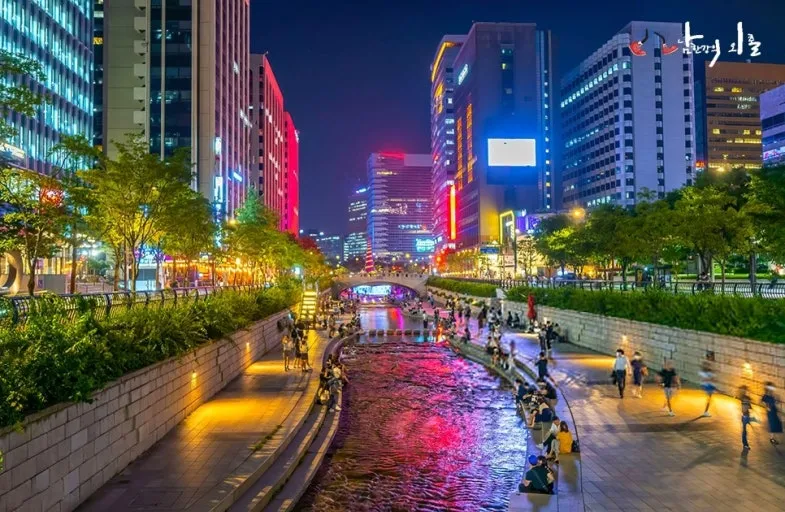
Stand at street level, and you see buses and glass buildings.
Step down to the water, and you see reflections and stone.
The difference is only a few meters in height.
But it feels larger.
Cheonggyecheon is not dramatic.
It is not wild.
It is engineered calm.
And in a city that rarely stops, that engineered calm is enough.