Bulguksa Temple in Gyeongju: Origins, Architecture, and Cultural Significance
The Road to Bulguksa
When people plan a trip to Korea, they often ask how to get to Bulguksa.
The question sounds practical.
Transportation, directions, distance.
But the road to Bulguksa has never been only about movement.
Bulguksa is located in Gyeongju, a city once known as the capital of the Silla Kingdom.
From Seoul, travelers usually take a high-speed train to Singyeongju Station and then continue by bus or taxi.
From central Gyeongju, local buses wind slowly toward the mountain where the temple rests.
The final approach is quiet.
Trees grow denser.
The air changes.
You do not arrive suddenly.
You ascend.
What Bulguksa Means
Bulguksa (불국사) literally means “Temple of the Buddha Land.”
“Bul” refers to Buddha.
“Guk” means nation or land.
“Sa” means temple.
The name does not describe a location.
It describes an idea.
This temple was built to represent the ideal world of Buddhism — a purified realm on earth.
It is not simply a place for worship.
It is a constructed vision of paradise.
The Origins and Historical Background
Bulguksa was originally established in the 8th century during the Unified Silla period.
The most well-known reconstruction took place under the patronage of Kim Daeseong, a high-ranking official.
According to historical records, he built the temple to honor both his present-life parents and his parents from a previous life.
The story reflects Buddhist belief in rebirth.
It also reflects filial devotion, which was deeply valued in Silla society.
Religion and family were not separate spheres.
Over centuries, the temple experienced destruction and restoration.
Wars and invasions damaged wooden halls.
Stone structures endured.
The temple seen today is the result of careful restoration, especially during the 20th century.
Yet the original layout remains faithful to its 8th-century vision.
What to See


When visitors enter Bulguksa, they do not step directly into the main hall.
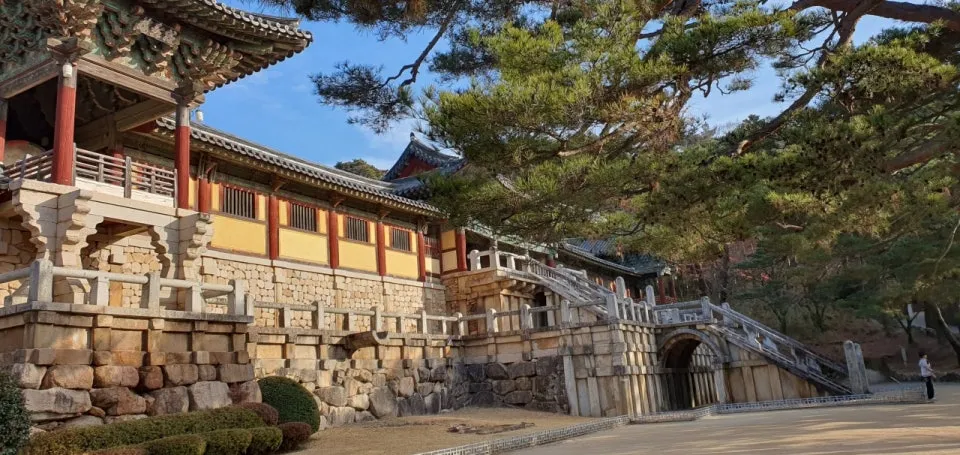
They first encounter stone stairways — Cheongungyo and Baegungyo.
These are not ordinary stairs.
They symbolize the passage from the human world to the Buddha’s realm.
Climbing them is symbolic ascent.
Beyond the stairs stands Daeungjeon, the main hall.
Inside sits the Buddha statue.
In the courtyard stand two famous pagodas — Dabotap and Seokgatap.
They appear side by side, but they are different in design.
Dabotap is elaborate and decorative.
Seokgatap is simple and restrained.
The contrast often draws attention.
But the two pagodas are not competing forms.
They represent different aspects of Buddhist teaching.
Balance is intentional.
Common Misunderstandings
Some visitors treat Bulguksa as a scenic attraction.
They photograph the pagodas.
They admire the symmetry.
They move on.
Others assume it is only a religious site for monks.
Both views are incomplete.
Bulguksa was constructed as a philosophical diagram in architectural form.
Every bridge, stair, hall, and pagoda reflects cosmology.
The temple is structured according to Buddhist concepts of enlightenment and transcendence.
Without that context, it can appear as merely beautiful stone and wood.
But beauty here is not decorative excess.
It is structured meaning.
Architectural Meaning
Bulguksa is carefully layered.
Lower terraces represent the earthly world.
Upper terraces represent the enlightened realm.
Stone dominates the lower structures.
Wood forms the halls above.
The physical transition from stone to wood echoes spiritual elevation.
The temple does not overwhelm.
Its scale is measured.
Compared to massive palace complexes, Bulguksa feels contained.
It is not built to intimidate.
It is built to guide.
The Cultural Context
During the Unified Silla period, Buddhism was not a private belief.
It was state ideology.
Temples expressed national identity.
Building Bulguksa was not simply a personal act of devotion.
It was political and symbolic.
It asserted Silla’s cultural sophistication.
It visualized a harmonious, ordered world under Buddhist principles.
This connection between religion and governance shaped the temple’s scale and ambition.
Even today, Bulguksa is recognized as a UNESCO World Heritage Site.
But long before global recognition, it functioned as a spiritual and national statement.
Visiting Today
Modern visitors buy tickets.
They follow designated paths.
They read informational signs.
Some arrive as tourists.
Some arrive to pray.
Monks still reside there.
Ceremonies still occur.
But the space accommodates cameras and quiet reflection side by side.
The mountain air remains steady.
The stone surfaces remain cool to the touch.
Despite reconstruction and preservation efforts, Bulguksa does not feel frozen in the past.
It feels maintained.
The temple does not demand that visitors understand every symbol.
It allows presence.
You climb the stairs.
You pass between pagodas.
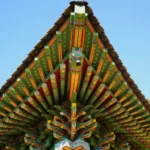
You look at the wooden beams.
And slowly, you realize that the journey was designed long before you arrived.
The road to Bulguksa is practical.
But the ascent is intentional.