Exploring Haeundae: Beyond the Beach
The Beach Everyone Knows
If you ask Koreans to name a beach, many will answer the same way.
“Haeundae.” (해운대)
Haeundae Beach is not just a stretch of sand in Busan. It is shorthand for summer itself.
But knowing the name and understanding the place are different things.
Haeundae is crowded in July. Windy in winter. Loud at night. Quiet at dawn.
It changes with the season, and Koreans experience it differently each time.
How to Get There
By Train (From Seoul)
Take the KTX high-speed train to Busan Station. From there, transfer to Busan Metro Line 2 and get off at Haeundae Station.
By Subway (Within Busan)
Busan Metro Line 2 → Haeundae Station → Exit 3 or 5 → 5–10 minute walk to the beach.
The station opens into a district of hotels, restaurants, and cosmetics stores before the sea appears. You walk through commerce before reaching water.
That transition is part of Haeundae.
What to See

Dongbaekseom
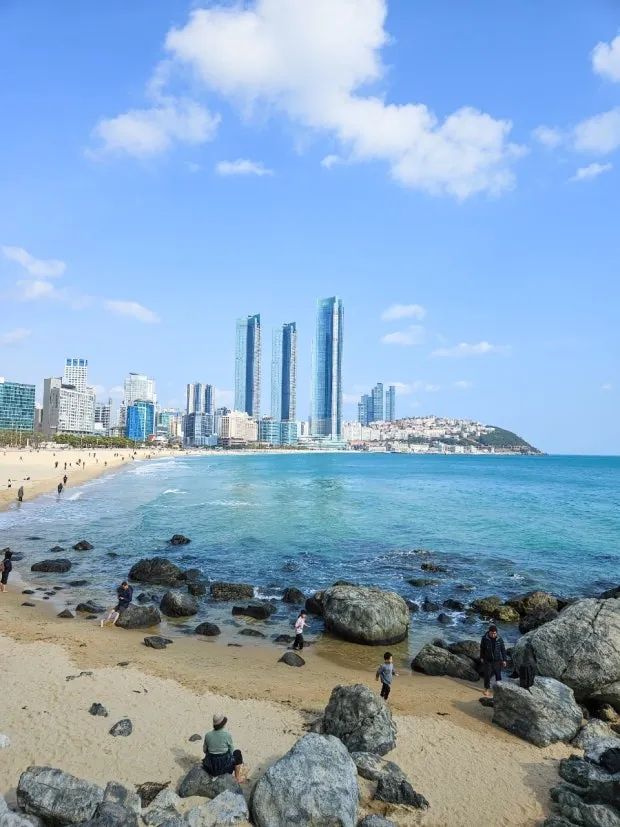
At one end of the beach is Dongbaekseom Island, though it is now connected by land. A walking path curves along the rocky coastline. Pine trees lean toward the sea.
Locals walk here early in the morning. Tourists follow slowly with cameras.
The view includes the skyline of Marine City—glass towers reflecting light.

The Bay 101
At night, people gather here to photograph illuminated skyscrapers across the water. The reflections feel cinematic.
It is less about swimming and more about atmosphere.
Couples linger. Tripods line the edge of the dock.

Haeundae Traditional Market
Just behind the main beach street is a compact local market. Fish cakes, hotteok, grilled seafood, tteokbokki.
Beach tourism and everyday food intersect here.
You can step from sand to street snacks within minutes.
Seasonal Differences

Haeundae in August is density.
Umbrellas packed closely together. Inflatable tubes. Loudspeakers. Lifeguards scanning the water.
Haeundae in January is distance.
The sand stretches wide and nearly empty. Wind moves uninterrupted. The sea looks darker.
Koreans often visit in winter just to walk. No swimsuits. Just coats and coffee.
The beach does not disappear when summer ends.
It shifts purpose.
What to Eat Near Haeundae
Seafood is expected.
Raw fish restaurants line certain streets. Grilled shellfish, seaweed soup, spicy fish stew.
But Haeundae is also modern. Trend cafés, dessert shops, and rooftop bars fill the blocks behind the main road.
It is possible to eat traditional seafood for lunch and finish the day with tiramisu and iced Americano overlooking the same water.
That contrast feels natural here.
The Feeling of Haeundae
Haeundae is not hidden. It is not quiet in peak season. It does not pretend to be untouched.
It is public, performative, sometimes excessive.
And yet, at sunrise, when the beach is almost empty, the skyline fades into pale light, and someone is jogging along the waterline, it feels unexpectedly simple.
Koreans return not because it is secret.
But because it is shared.
School trips. Summer vacations. Fireworks festivals. New Year’s sunrise.
Memories accumulate here collectively.
A Place That Holds Crowds
There are beaches in Korea that feel more private.
Haeundae is not one of them.
It absorbs crowds.
It stages events.
It becomes backdrop and foreground at once.
You can swim. You can photograph. You can sit with coffee and watch others.
The sand carries footprints that disappear by morning.
The name remains.
Haeundae.
For many Koreans, it is less a destination and more a recurring scene.