Visiting Gamcheon Culture Village: A Guide with History and Travel Tips
Why Are the Houses Stacked Like That?
When people first see Gamcheon Culture Village, they often react to the colors.
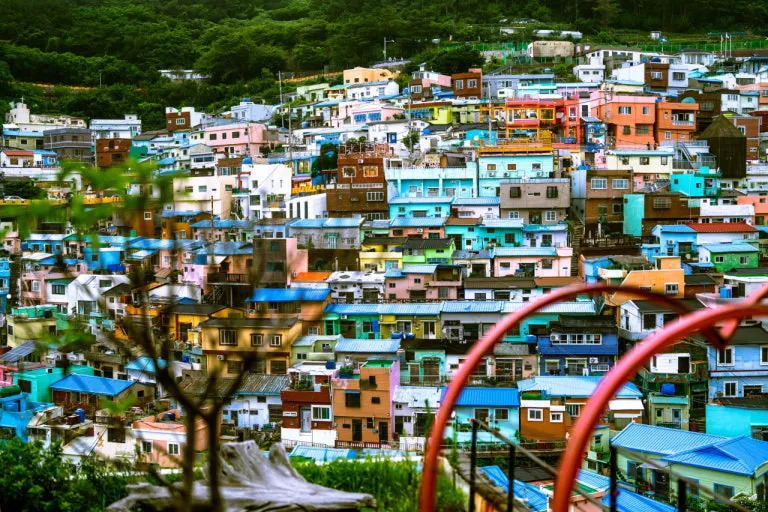
Blue, pink, mint, yellow. Houses stacked along a steep hillside, facing the sea in the distance. From above, it looks intentional—almost like a planned art installation.
But the shape of the village came first. The color came later.
And that difference matters.
The History Before the Paint

Gamcheon began forming in the 1950s during the Korean War.
As refugees fled south, many settled in Busan. The city’s flat areas were already crowded, so new residents moved toward the hillsides. Houses were built quickly, often modestly, along the slopes.
The structure of the village followed necessity.
Homes were arranged in tiers so that each roof would not block the sunlight of the house below. Narrow alleys connected one level to the next. Stairs replaced streets in many places.
For decades, Gamcheon was known not as a cultural site but as a poor hillside neighborhood.
The word “culture” did not belong to it yet.
The Cultural Village Project
In 2009, a public art project began.
Artists collaborated with residents to introduce murals, installations, and small exhibition spaces throughout the neighborhood. Walls were painted. Empty houses were reused. Signage was added to guide visitors.
That was when the name “Gamcheon Culture Village” became widely used.
The transformation was not a demolition and rebuild. It was an overlay.
The daily life of residents continued.
Tourism was added on top of it.
How to Get There
Gamcheon is located in Saha-gu, Busan.
By Subway
Take Busan Subway Line 1 to Toseong Station.
From Exit 6, transfer to a local village bus (commonly Saha 1-1 or Saha 2) and get off at Gamcheon Culture Village.
By Taxi
From central Busan areas such as Nampo-dong, taxi travel typically takes about 15–20 minutes depending on traffic.
The entrance area already slopes upward. Comfortable shoes are not optional.
What to See
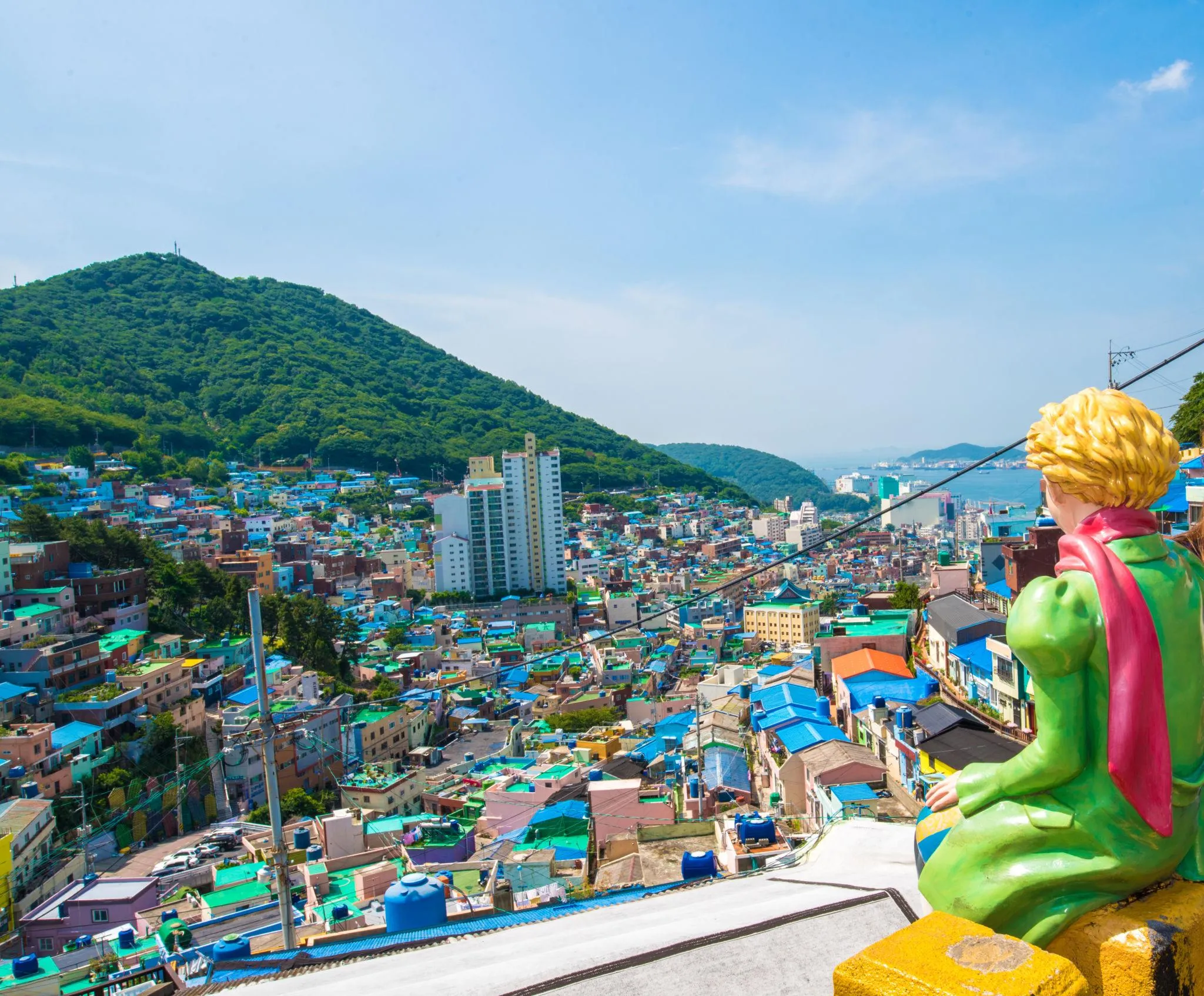
The Little Prince and the Fox
One of the most photographed spots in the village is the statue inspired by “The Little Prince.” Visitors line up to sit beside it, facing the layered houses and distant sea.
Murals and Alley Art
The village’s walls function as an open-air gallery. Paintings appear around corners, beside staircases, and along narrow passageways.
The art encourages wandering rather than direct movement.
Observation Points
Climbing higher reveals a panoramic view of the stacked houses. From this angle, the logic of the layout becomes clearer.
Small Cafés and Craft Shops
Along the main walking routes, small cafés and souvenir shops operate within former residential buildings.
But beyond certain corners, laundry still hangs. Doors open and close for ordinary reasons.
A Tourist Site That Is Still a Neighborhood
Gamcheon is not a theme park.
People live there.
You will see signs requesting quiet behavior. You will notice restricted areas marked as residential zones. The village depends on tourism, yet it also negotiates its limits.
This dual identity shapes the atmosphere.
Visitors walk slowly with cameras. Residents carry groceries uphill.
The two rhythms overlap.
When to Visit
Midday can be crowded, especially on weekends.
Morning or late afternoon offers softer light and slightly fewer visitors. As the sun lowers, the colors of the houses shift subtly.
The hillside casts longer shadows.
The village becomes quieter.
What Gamcheon Reveals
At first glance, Gamcheon appears cheerful.
But the structure of the village tells a different story—one of displacement, adaptation, and survival.
The paint brightens the walls.
It does not erase the slope.
When you climb the stairs, you feel the incline in your legs. The geometry of necessity remains beneath the decoration.
From above, the houses appear almost carefully arranged.
Up close, you see small repairs, uneven steps, wires running along walls.
It is both curated and uncurated.
Gamcheon Culture Village did not begin as an attraction.
It became one.
And beneath the color, the hillside still holds its original shape.