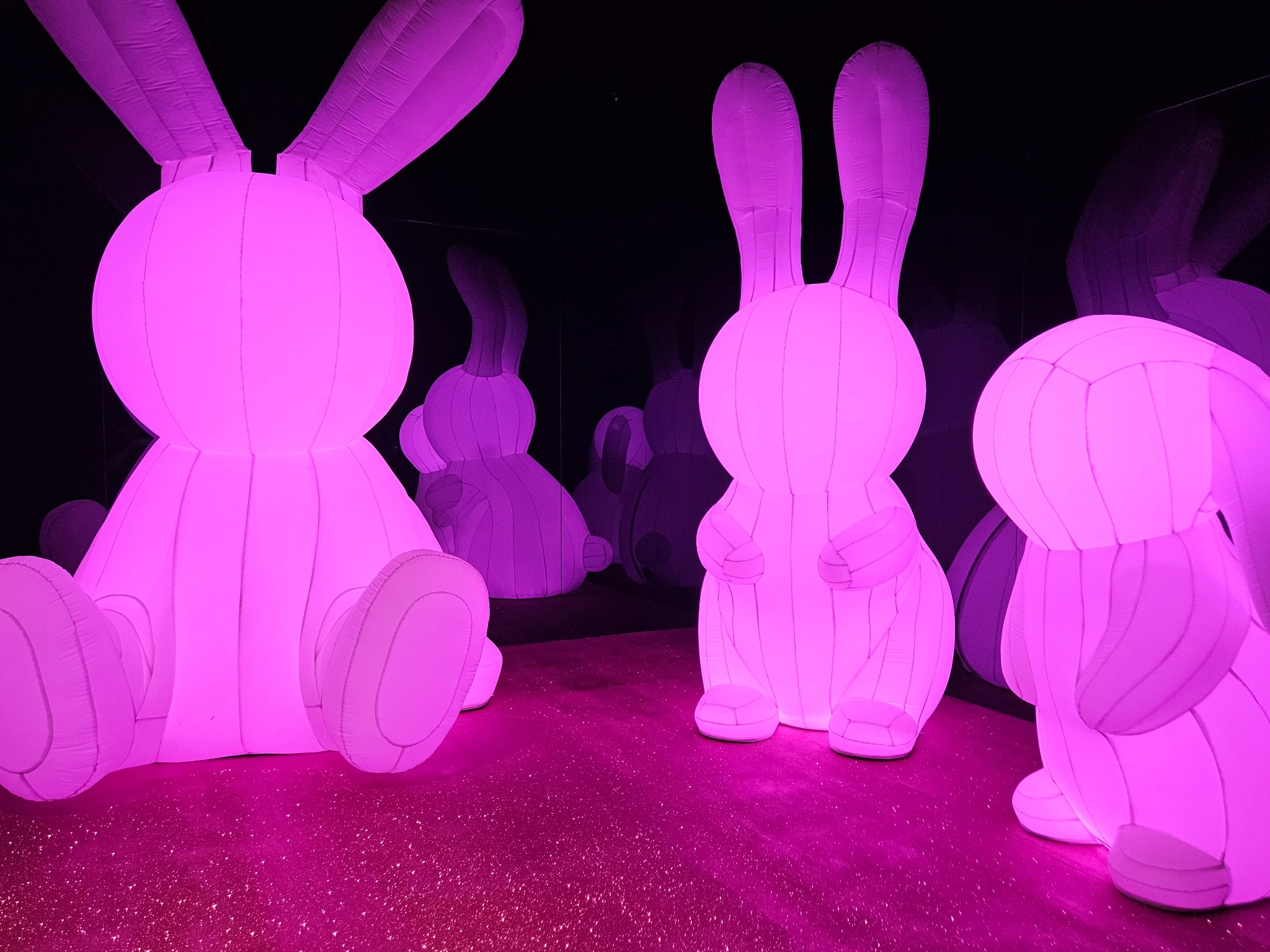
Inside Arte Museum Yeongdo: Busan’s Immersive Media Art Space
Entering the Dark in Yeongdo
When you cross into Yeongdo, the mood shifts slightly.
Bridges connect it to the rest of Busan, but there is always a small sense of separation. The sea surrounds the district. The streets feel quieter, less hurried.
Inside this setting stands Arte Museum Yeongdo.
From the outside, the building does not reveal much. It feels contained. Almost windowless. There is little indication of what waits inside.
You enter not into brightness, but into darkness.
And that darkness is deliberate.
Immersion Without Edges
Arte Museum is known for immersive media exhibitions—large-scale projections, moving light, soundscapes that fill entire rooms.
Unlike traditional museums, there are no framed paintings on white walls. No small plaques beside still objects.
Instead, entire walls move.
Flowers bloom across black space. Waves rise from floor to ceiling. Light shifts in slow cycles, synchronized with music.
The word often used is “immersive.”
In Korean, people sometimes say, “빠져든다.” (You get absorbed.)
The translation is simple. But the feeling is more physical than the word suggests.
You do not stand in front of art.
You stand inside it.
The Digital Ocean
In Busan, a city defined by water, the ocean-themed rooms feel especially fitting.
Waves crash across towering screens. The sound fills the dark space. Reflections shimmer across the floor. Visitors stand quietly, watching the cycle repeat.
Some sit against the wall. Some lie briefly on the floor to feel surrounded.
The ocean inside the museum is not wet. It is controlled. Repeating. Predictable.
Yet people respond to it as if it carries weight.
Children reach out to touch projected petals. Adults hold up phones to record slow-moving scenes.
The light washes over everyone equally.
Behavior in the Dark
There is something about darkness that changes posture.
Voices lower automatically. Footsteps soften. Strangers stand closer without discomfort.
In everyday Korean life, physical space can feel carefully managed. Here, the boundaries blur slightly.
People move slowly, adjusting to changing light. The absence of natural light removes the sense of time. You do not know if you have been inside for ten minutes or an hour.
Phones glow occasionally, but even screens feel dim compared to the projections.
The space encourages quiet awe rather than loud reaction.
A Museum for Photographs?
Arte Museum is often described as “photo-friendly.” The rooms are visually dramatic. Colors saturate skin and clothing. Videos shared online show glowing flowers, endless waterfalls, shifting forests.
It would be easy to dismiss it as purely visual spectacle.
But watching people inside complicates that idea.
Many take photos, yes. But they also pause longer than a single image requires. They stand still. They wait for a sequence to complete before moving on.
There is patience.
The exhibition cycles repeat, but viewers rarely rush.
A Different Kind of Art Space
Traditional museums can feel instructional. There is information to read, context to absorb, history to understand.
Arte Museum offers minimal explanation.
There are themes—nature, light, season, space—but interpretation is not guided heavily.
You are not told what to think.
You are simply placed inside atmosphere.
For some, this feels refreshing. For others, it feels abstract.
Both reactions coexist quietly.
Yeongdo and Containment
Yeongdo itself carries an island-like identity within Busan. Historically associated with shipbuilding and port life, it has gradually become a site for cultural spaces and quieter tourism.
Placing an immersive digital museum here creates an interesting contrast.
Outside: real sea, real wind, working docks.
Inside: projected waves, controlled light, enclosed darkness.
The two oceans face each other across a short distance.
One unpredictable.
One repeating.
Visitors step from one into the other.
Leaving the Projection
When you exit the final room, light feels abrupt.
Your eyes adjust slowly. The outside world seems sharper, less filtered.
If you visit in the afternoon and step out toward evening, the real sky feels unexpectedly dimensional after so much digital immersion.
You might glance at the actual sea beyond Yeongdo’s edges and notice its irregularity—the way waves refuse synchronization.
Arte Museum does not attempt to replace that reality.
It creates a contained version of it.
For an hour or two, you stand inside light that behaves perfectly.
Then you return to light that does not.
What Remains
Arte Museum Yeongdo is not about possession. There is nothing to take home except photographs and memory.
It is also not about narrative resolution. The projections loop. The flowers bloom endlessly. The ocean repeats.
You leave without a conclusion.
Perhaps that is part of its appeal.
In a city defined by movement and noise, the museum offers darkness and controlled spectacle. You stand quietly among strangers, watching the same digital tide rise and fall.
For a moment, everyone faces the same wall of light.
And then the door opens.