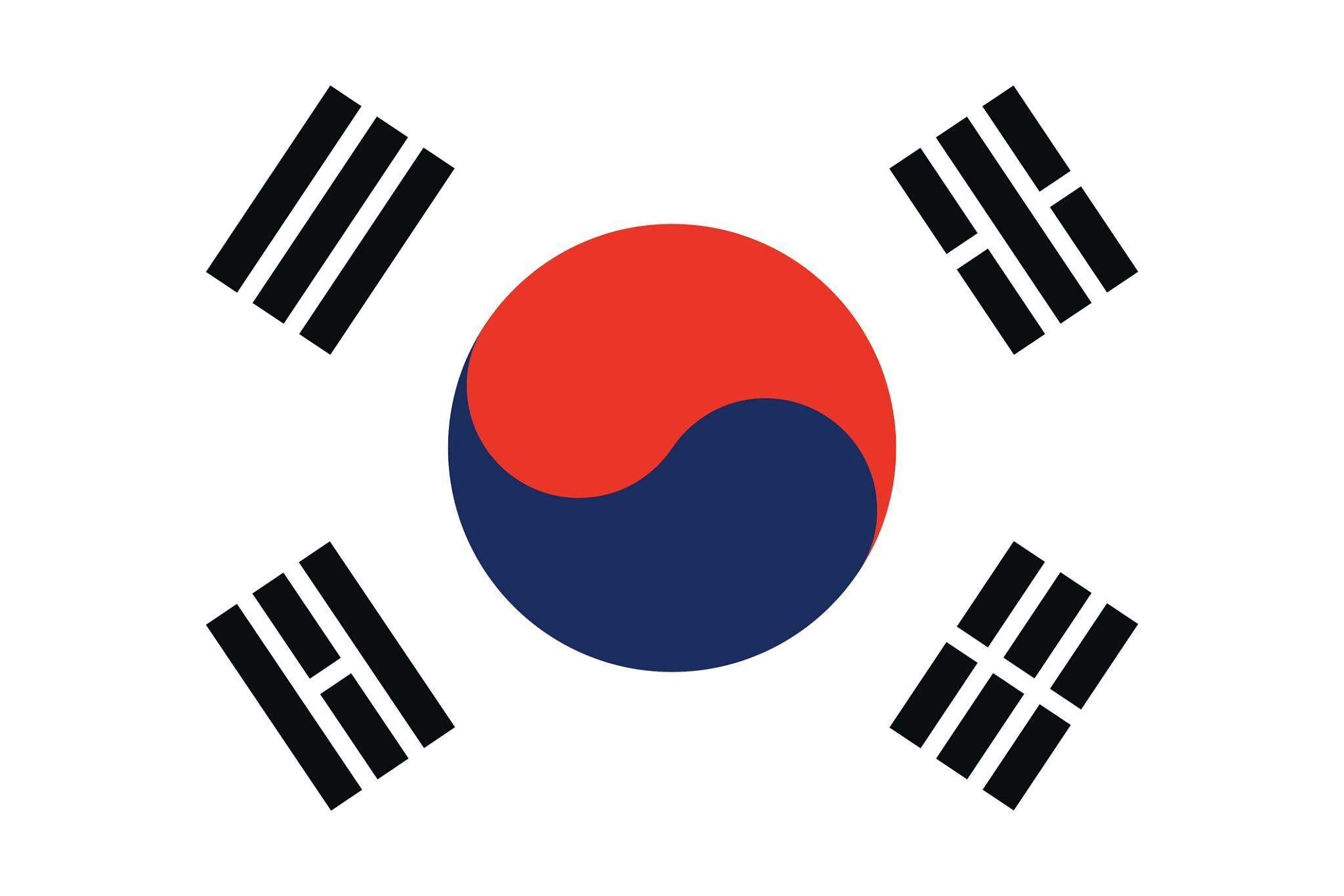
The Meaning of the Korean Flag (Taegeukgi): Symbolism, History, and Philosophy Explained
The Korean flag, known as Taegeukgi (태극기), is far more than a national emblem. It is a visual philosophy—an elegant design that represents balance, harmony, cosmic order, and Korea’s historical journey.
In this post, we will explore:
- The meaning of the Taegeuk symbol
- The symbolism of the four trigrams
- The meaning of the white background
- The historical origins of Korea’s national flag
📜 1. The History of Taegeukgi
The Taegeukgi was officially adopted in 1883, during the late Joseon Dynasty.
At the time, Korea needed a national flag to represent itself in diplomatic relations with foreign powers. The design was influenced by East Asian philosophical concepts, particularly Yin-Yang (Um-Yang in Korean) and the I Ching (Book of Changes).
During the Japanese colonial period (1910–1945), the Taegeukgi became a powerful symbol of resistance and independence. Protesters during the March 1st Independence Movement (1919) waved it as a symbol of Korean identity and sovereignty.
After liberation in 1945, it was officially reaffirmed as the national flag of the Republic of Korea.
☯ 2. The Taegeuk Symbol (Red and Blue Circle)
At the center of the flag is the Taegeuk (태극), a red and blue circle divided in a swirling pattern.
- 🔴 Red (Yang) represents positive cosmic forces: light, warmth, masculinity, and activity.
- 🔵 Blue (Um/Yin) represents opposing but complementary forces: darkness, coolness, femininity, and receptivity.
Together, they symbolize balance and harmony in the universe.
Neither force dominates. Instead, they coexist in dynamic equilibrium.
This concept reflects a core Korean worldview: harmony between opposites.
🔲 3. The Four Trigrams (Geon, Gon, Gam, Ri)
Surrounding the Taegeuk symbol are four black trigrams called Geon (☰), Gon (☷), Gam (☵), and Ri (☲).
Each represents a natural element and universal principle:
| Trigram | Meaning | Element | Symbolizes |
|---|---|---|---|
| ☰ Geon | Heaven | Sky | Creation, strength |
| ☷ Gon | Earth | Ground | Receptivity, nurturing |
| ☵ Gam | Water | Water | Wisdom, adaptability |
| ☲ Ri | Fire | Fire | Passion, clarity |
Together, they represent the balance of the universe and the interaction of cosmic forces.
The trigrams come from ancient East Asian philosophy and reflect the idea that reality is built on dynamic relationships.
⚪ 4. The White Background
The white field of the Taegeukgi is deeply meaningful.
Historically, Koreans were known as the “White-Clad People” because white clothing was commonly worn in daily life.
White symbolizes:
- Peace
- Purity
- Integrity
- The Korean people’s love of harmony
The background emphasizes that the cosmic balance represented by the Taegeuk exists within a peaceful and moral society.
🇰🇷 5. Taegeukgi as a Symbol of Identity
The Taegeukgi is not merely decorative.
It represents:
- Philosophical balance
- Cultural continuity
- Historical resilience
- National sovereignty
It is raised during national holidays such as Independence Movement Day (March 1) and Liberation Day (August 15), reminding Koreans of their history and values.
Today, it stands as a powerful symbol of Korea’s identity in the global community.