Understanding Korea’s Habit of Holding Seats with Personal Items
Why Koreans Leave Their Belongings to Save a Seat
If you visit Korea for the first time, there is a small moment that can feel strangely unsettling.
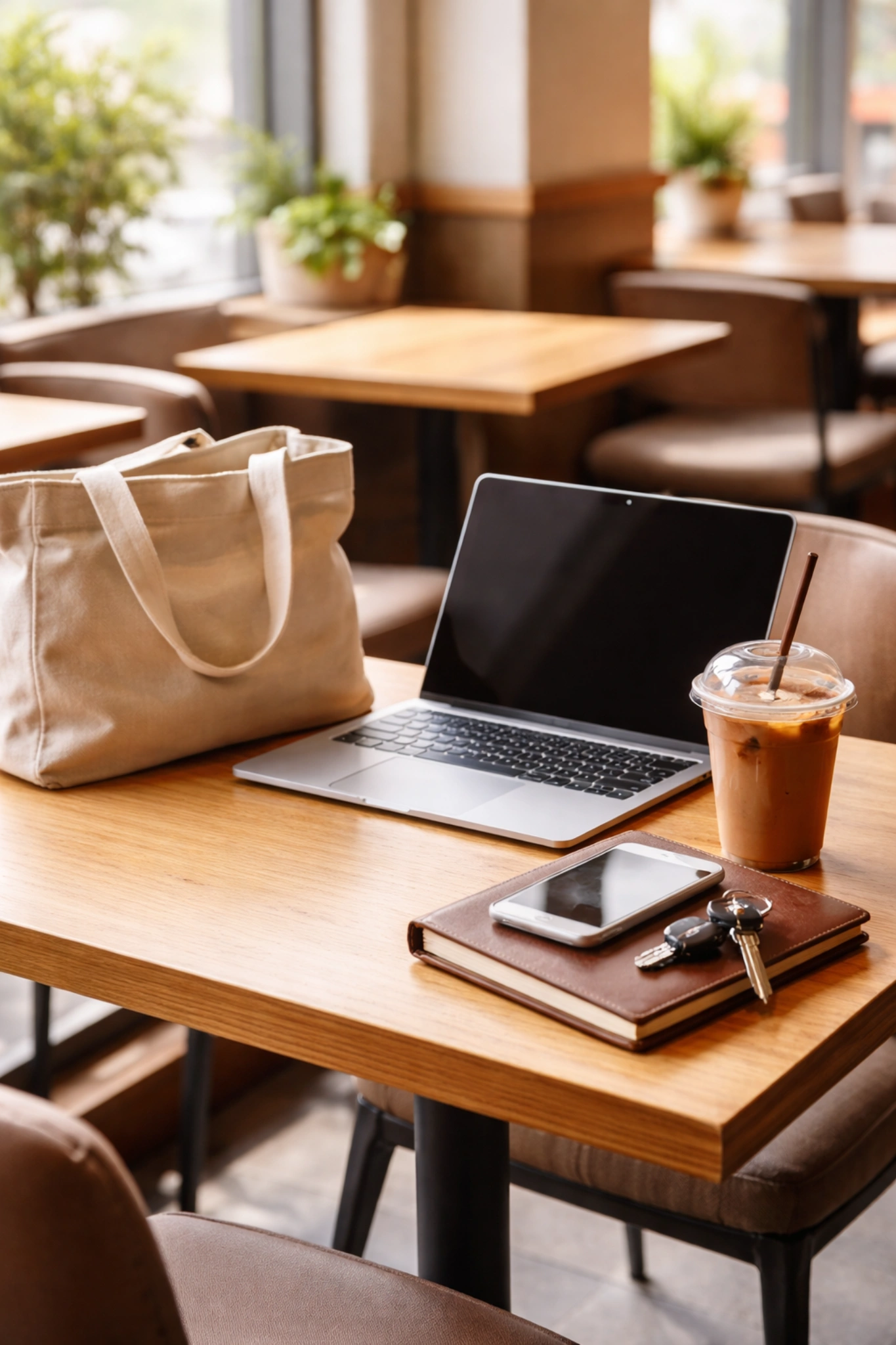
You walk into a busy café. Every table looks occupied. But when you look closer, you see something unusual. On one table, there is only a phone. On another, a tote bag. On another, a laptop left open. No people. Just objects.
And yet no one sits there.
In many countries, this would feel risky or careless. A phone left alone might disappear. A bag without its owner might invite suspicion. But in Korea, this is ordinary. It is not seen as careless. It is understood as a message.
The message is simple:
“This seat is taken.” (자리 맡았어요)
The literal meaning of “자리 맡다” is “to take responsibility for a seat” or “to hold a seat.” But in practice, it means placing a personal belonging on a table before ordering or before leaving briefly. The object becomes a placeholder. It stands in for the body.
No one announces it. No one negotiates it. It is simply recognized.
The Object as a Person
In Korea, a bag on a chair is not just a bag. It represents someone who intends to return. The object extends the person’s presence into space.
You might see a student enter a café, quickly place her laptop on a table, and then go stand in line to order. Or someone in a food court might leave their jacket at a table before buying food. The act is quick and casual. There is no hesitation.
What is interesting is not just the behavior itself, but the collective agreement around it. Everyone knows what it means. Everyone pretends the person is already there.
No one sits down and says, “But the seat is empty.”
Because in a way, it is not.
A Practice Built on Quiet Trust
From the outside, this habit often looks like trust. And yes, trust is part of it. Korea has relatively low rates of petty theft compared to many places. People do leave laptops unattended for short periods. Phones sit alone on tables.
But trust alone does not fully explain it.
The behavior also reflects a shared understanding of order in crowded spaces. Korea is dense. Cities like Seoul are tightly packed. Cafés are full. Food courts are busy. During lunch hours, especially in business districts, finding a seat can feel competitive.
In that environment, the act of placing an object first becomes a quiet claim. It prevents awkward negotiation later. It reduces confrontation.
It is not about ownership in a legal sense. It is about signaling intention.
And Koreans are often sensitive to signals.
Avoiding Direct Conflict
There is another layer beneath this habit.
In Korea, direct confrontation over small matters is usually avoided. Arguing over a table feels excessive. Asking, “Is anyone sitting here?” when there is clearly a bag already on the chair would be considered unnecessary.
The object eliminates the need for conversation.
It is a silent agreement between strangers:
“I won’t challenge your claim if you don’t challenge mine.”
This mutual restraint keeps public spaces moving smoothly. No one needs to explain themselves. No one needs to defend their place.
Sometimes it works so seamlessly that no one thinks about it at all.
Common Misunderstandings
Visitors sometimes feel shocked seeing expensive electronics left unattended. They may interpret it as extreme safety or naïveté. Some even test it, watching to see if anything will be stolen.
Others feel frustrated. They see empty seats in a crowded café and wonder why objects are allowed to occupy space when people are standing.
From a different cultural background, saving a seat might require a person to physically stay there. The idea that an object alone is enough can feel unfair.
But in Korea, fairness is not measured by physical presence alone. It is measured by sequence.
Who arrived first?
Who placed their belonging first?
The object marks order. And order matters.
The Subtle Hierarchy of Objects
Not all objects carry equal weight.
A phone, wallet, or laptop signals strong intention. A tissue or a cheap pen might feel weaker, almost playful. In some cafés, people use small items like a notebook or even a single book to hold a table. And still, it works.
The power of the object is not in its price. It is in the shared understanding behind it.
But there are limits.
If someone leaves belongings for too long—especially in a very crowded place—people may start to feel quiet irritation. The social contract assumes brief absence. Ten minutes feels different from an hour.
No one announces this limit. It is felt.
Why It Continues
In recent years, discussions about “café culture” in Korea have grown. Study cafés, long hours spent working on laptops, the expectation of buying only one drink and staying for hours—these behaviors sometimes create tension between customers and business owners.
And yet, the practice of saving seats remains.
Part of the reason is rhythm. Koreans are accustomed to moving quickly in public spaces. You enter, claim a table, order, return. The sequence is efficient.
Another reason is collective predictability. Because most people follow the same unwritten rule, the system sustains itself.
If everyone suddenly refused to recognize objects as placeholders, chaos would follow. So people continue to recognize them.
Even without thinking.
A Small Habit That Reveals Something Larger
It is easy to dismiss this as a minor behavioral quirk. Just a café habit.
But it reveals something about how Koreans navigate shared space. Presence does not always require a body. Intention can be enough. A quiet signal can replace spoken negotiation.
And perhaps it also reflects something else.
In a society where many interactions are guided by unspoken rules, learning to read signals becomes essential. A bag on a chair. A phone on a table. A jacket draped casually across a seat.
None of them speak.
But everyone understands.
Sometimes I watch an empty table with a single phone resting in the center. People walk by, glance at it, and continue searching. No one questions it. The invisible person is respected.
The café remains full of people who are not entirely visible.